
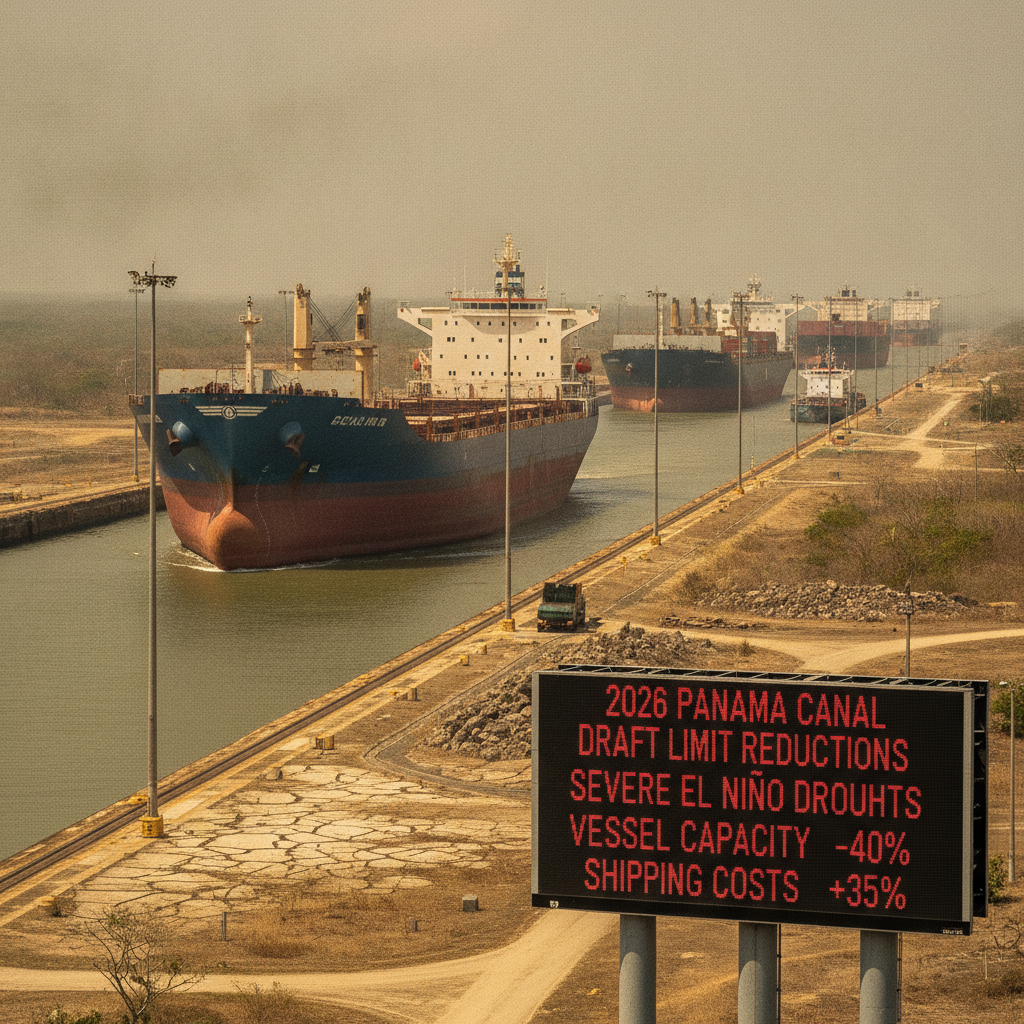
Logistics professionals are bracing for significant supply chain disruptions as the Panama Canal Authority (ACP) implements new operational constraints. In late 2026, the maritime industry faces severe Panama Canal draft limit reductions driven by historic El Niño drought conditions impacting Gatun Lake’s water levels.
Analyzing Panama Canal draft limit reductions
The ACP recently revised its transit guidelines to conserve freshwater resources during an intensifying dry season. For Neopanamax vessels, the maximum authorized draft is being scaled back to 48 feet (14.63 meters) in early September, with further downward adjustments to 47.5 feet planned for October. Simultaneously, daily vessel transits are being reduced from 36 to 32 by mid-September. These dual constraints are forcing ocean carriers to reevaluate their routing and payload strategies for the US East and Gulf Coast lanes.
How Panama Canal draft limit reductions Impact Capacity
For container shipping, draft restrictions translate directly to lost payload capacity and inflated freight costs. Industry experts note the following impacts:
- A standard 10,000-TEU containership loses roughly 450 TEUs of capacity for every single foot of draft restricted.
- Major ocean carriers, including ONE and MSC, have already implemented surcharges of up to $150 per TEU to offset revenue losses.
- Waiting times for vessels without pre-booked transit slots have spiked, averaging over eight days for northbound routes.
Weather Driving Panama Canal draft limit reductions
The root cause of these operational hurdles is a severe hydrologic deficit in the region. Recent data shows that rainfall across the Canal watershed between May and August 2026 was 34% below the historical average, while watershed inflows plummeted by 44%. As meteorologists forecast an exceptionally strong 2026-2027 El Niño event, the ACP is strategically rationing water to secure operations through the upcoming dry season. Supply chain managers must proactively adapt to these evolving restrictions to mitigate delays and budget overruns.