East Asia Typhoon Logistics Disruptions: 2026 Supply Chain Crisis?
The 2026 typhoon season has unleashed unprecedented challenges for global trade networks. With successive storms like Typhoons Bavi, Dolphin, and Saudel battering the coastline, East Asia Typhoon Logistics Disruptions have reached critical levels. Shipping operations are experiencing compounding delays as ports race to recover from rolling closures.
Managing East Asia Typhoon Logistics Disruptions at Major Hubs
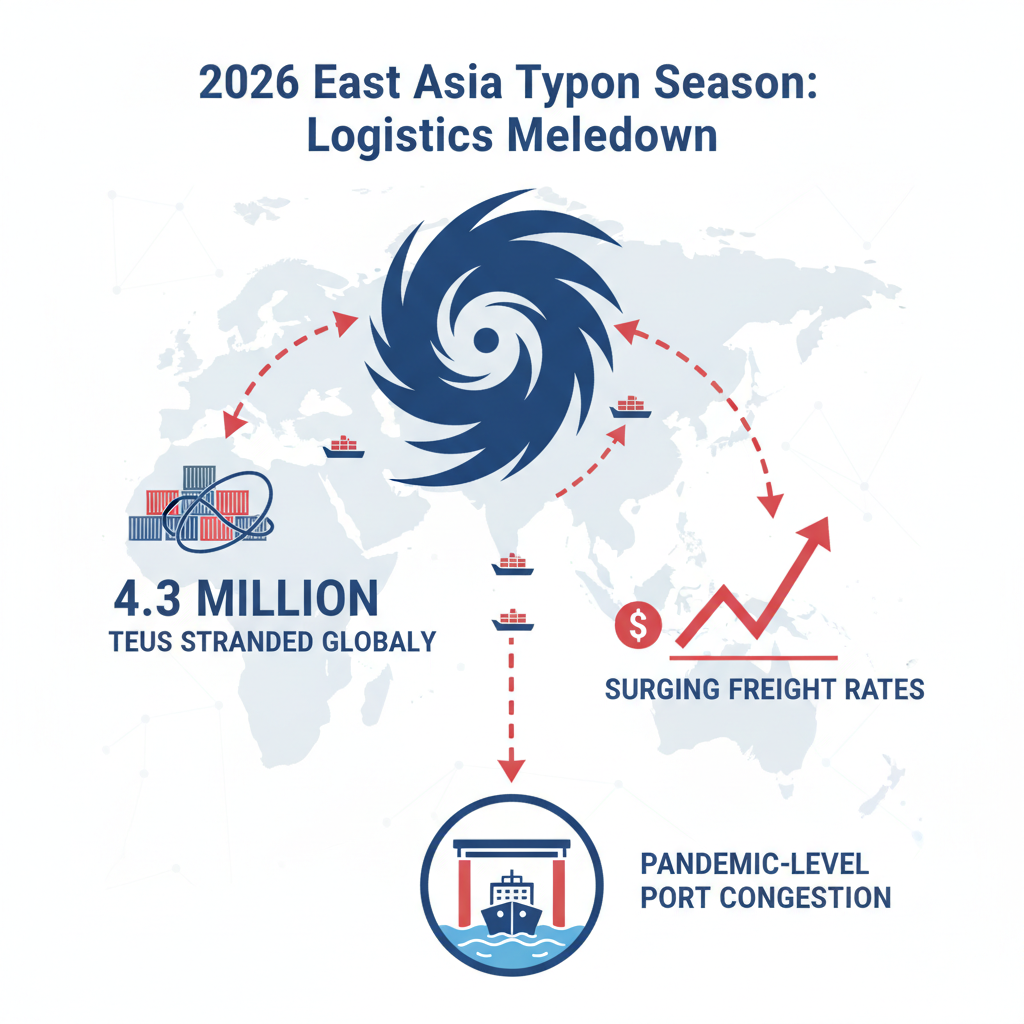
Recent maritime data indicates that global port congestion has surpassed peak pandemic levels. North Asian facilities are bearing the brunt of these severe weather events. Key statistics highlighting the severity of the crisis include:
- Global stranded container capacity has exceeded 4.3 million TEUs, representing roughly 12.6% of the world’s fleet.
- North Asia accounts for approximately 50% of this congestion, trapping over 2.2 million TEUs around Chinese ports.
- Vessel berthing delays at major hubs like Shanghai and Ningbo-Zhoushan have stretched between 9 and 14 days.
Because of these operational bottlenecks, schedule reliability has plummeted to 60% across regional shipping lanes.
Freight Rates and East Asia Typhoon Logistics Disruptions
The capacity constraints are placing significant upward pressure on international freight rates. North Asia-to-U.S. West Coast spot rates recently climbed to $7,900 per FEU, reaching highs not seen since June 2022. Industry analysts advise logistics experts to build maximum flexibility into their supply chains to navigate ongoing East Asia Typhoon Logistics Disruptions.
References
- Typhoon Saudel Adds Fresh Delays Across Asia’s Container Network (Sept 2026).
- SEKO Logistics: China Port Congestion Updates (Sept 2026).
- APL Logistics Customer Advisory: Typhoon Saudel (Aug 2026).
- Congested Chinese Ports Cause Supply Chain Operation Issues.
- Vantage Logistics: Typhoon Disruptions Trigger Severe Congestion.