
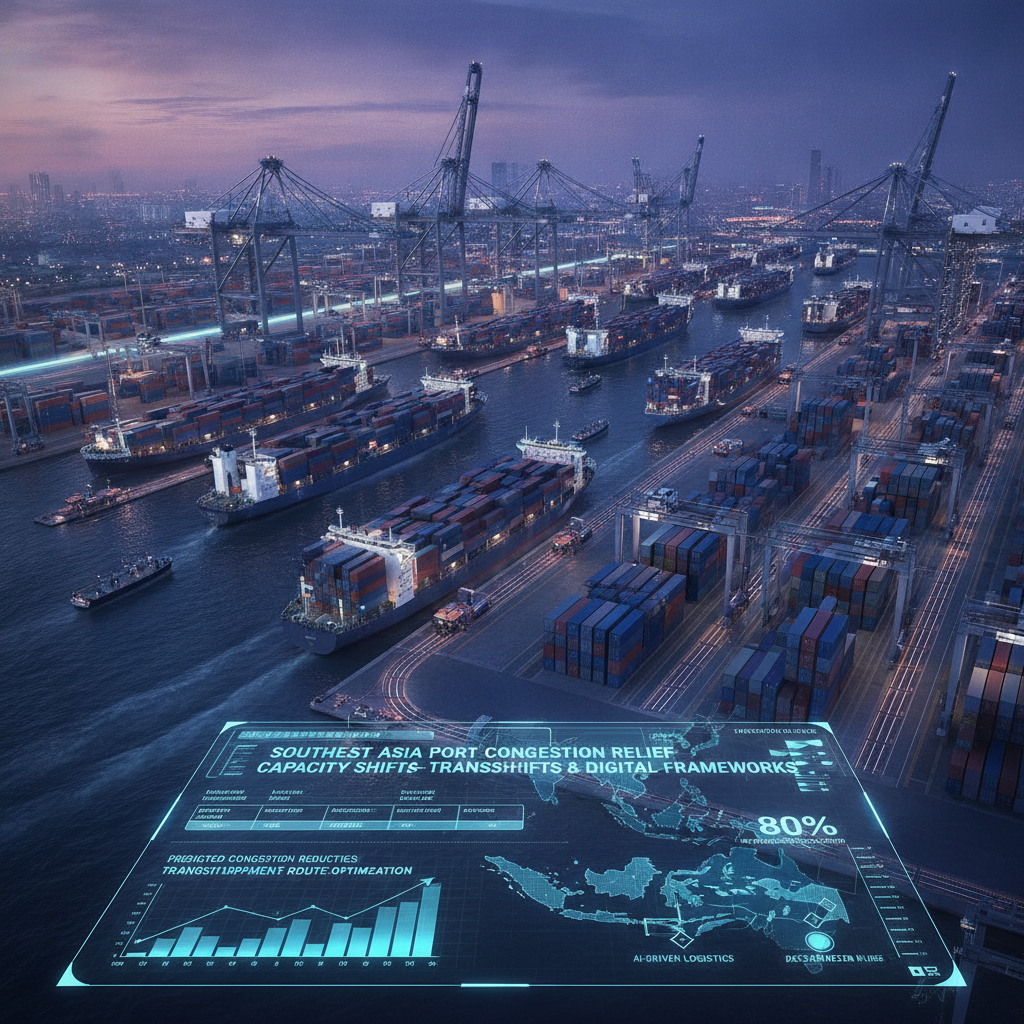
As maritime logistics navigate the ongoing fallout of Red Sea vessel diversions, Southeast Asia has found itself at the epicenter of a transshipment crisis. Throughout 2024 and early 2025, regional hubs like Singapore experienced yard utilization rates surging to 95%, with berthing delays extending up to seven days and over 450,000 TEU sidelined. However, recent developments in late 2025 and early 2026 signal a crucial pivot toward Southeast Asia port congestion relief through structural adjustments and strategic cargo rerouting.
To alleviate the unprecedented bottlenecks, carriers have increasingly decentralized their operations. While Singapore handles over 40 million TEU annually, the spillover effect has catalyzed capacity upgrades at neighboring facilities. Industry data from mid-2025 revealed that prolonged average wait times of 1.5 to 2 days prompted major shipping lines to adjust schedules, skipping the most congested nodes. These tactical diversions, combined with proactive yard management and digitalization frameworks like MPAC 2025, are slowly unblocking critical feeder routes and enabling much-needed Southeast Asia port congestion relief.
For logistics experts navigating 2026, the pathway to sustainable recovery relies heavily on data-driven planning and synchronized infrastructure investment. Supply chain operators are booking capacity earlier and exploring alternative transshipment networks to hedge against volatility. While complete normalization remains contingent on global geopolitical stabilization, the regional logistics landscape is adapting rapidly to prevent a recurrence of peak 2025 delays. Agile network designs will remain paramount.
References
FreightAmigo (2025)
GoComet (2025)
Supply Chain Industry Reports (2025)
Tradlinx (2025)