
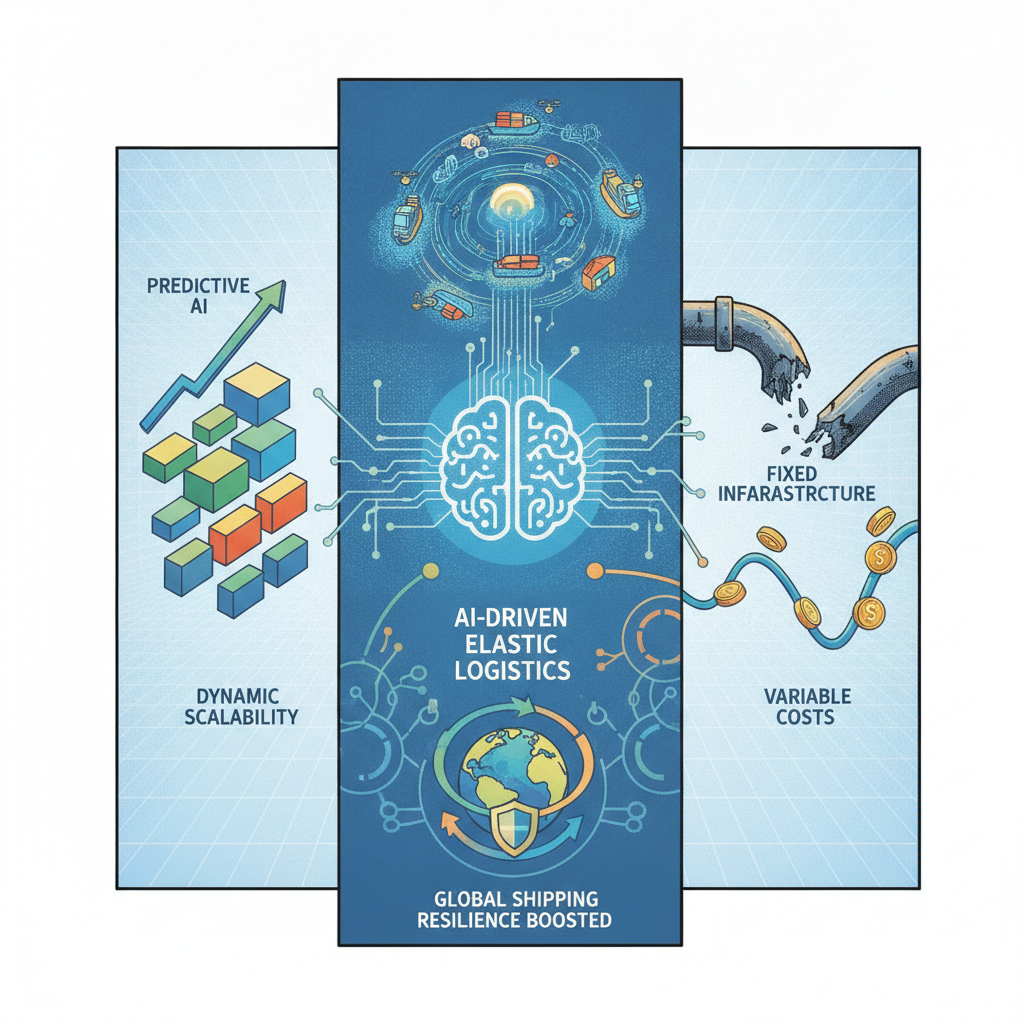
As the global supply chain transitions into 2026, traditional fixed-capacity models are rapidly becoming obsolete. Industry experts are pivoting to AI-Driven Elastic Logistics, an agile framework that allows businesses to scale operations up or down dynamically in response to market volatility. Faced with U.S. delivery costs surging 12% between 2024 and 2025, operators are replacing rigid contracts with flexible, variable-cost infrastructures. Today’s elastic logistics leverages Generative AI and IoT data to evolve from merely reactive measures to proactive predictive positioning.
By monitoring geopolitical shifts, climate events, and port congestion in real-time, AI systems can instantly re-route shipments via multimodal paths within milliseconds. This critical shift from fixed scheduling to dynamic route optimization has been shown to boost enterprise supply chain resilience by over 90%. Furthermore, anticipating demand is now highly localized. In 2026, AI can predict SKU demand for specific cities with an accuracy rate exceeding 95%. This enables anticipatory logistics, where goods are pre-deployed to regional distribution centers before consumers even place orders.
- The global e-commerce logistics market is projected to reach USD 923 billion by 2028, growing at a 15.1% CAGR.
- The specialized elastic logistics sector is expected to grow at a 9.4% CAGR through 2032.
- Last-mile delivery currently accounts for up to 53% of total shipping costs, necessitating AI-managed capacity sharing.
Ultimately, AI-Driven Elastic Logistics eliminates the heavy burden of underutilized proprietary infrastructure. By paying only for active capacity, shipping enterprises achieve extreme dispatch elasticity while maintaining competitive margins.
References
- , 2026 Asia Logistics: AI Supply Chains and Green E-commerce Trends
- What is Elastic Logistics and how it is redefining business scaling in 2026 – MBE Franchise