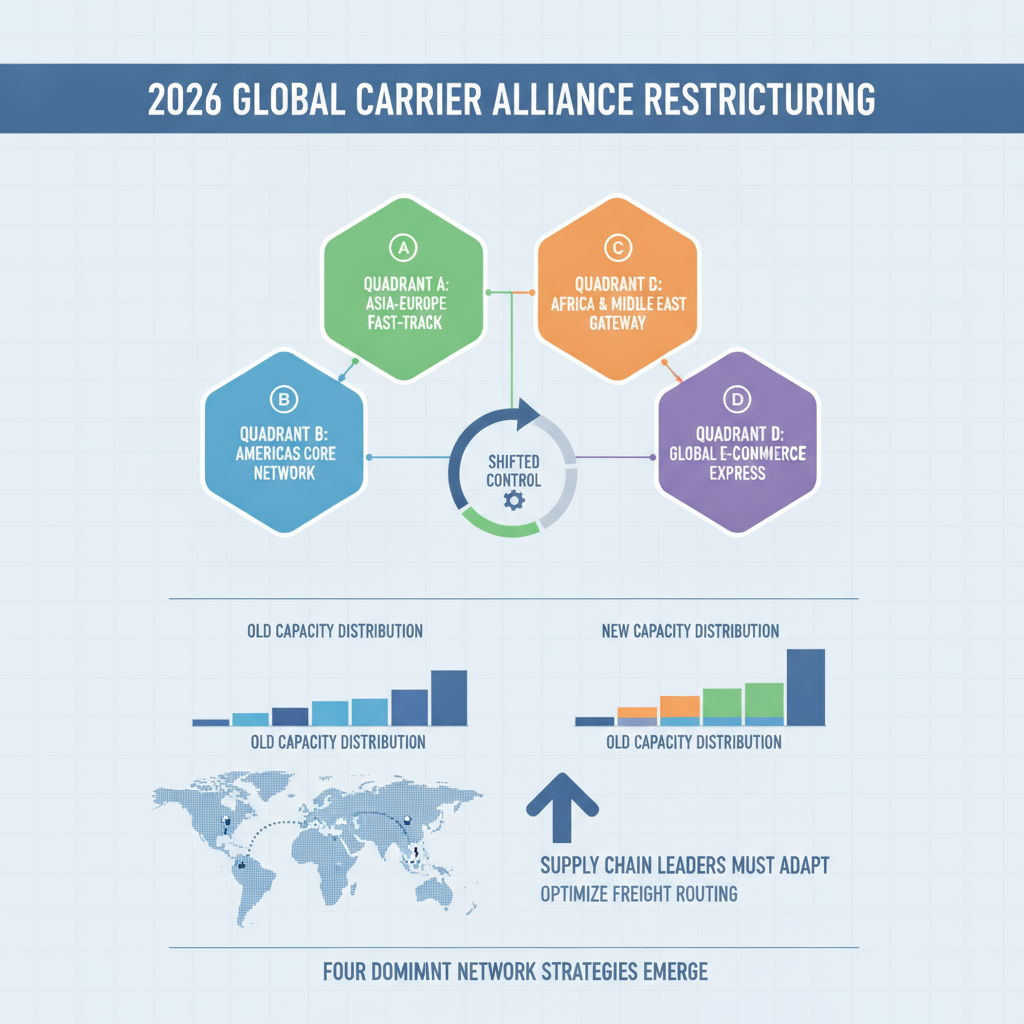
The recent global carrier alliance restructuring has fundamentally transformed container shipping networks, shifting the market from three legacy coalitions to four dominant operating structures. As of mid-2026, alliance networks dictate over 80% of deployed capacity across critical East-West trade lanes, with transpacific concentration approaching an unprecedented 85%. This immense consolidation forces logistics professionals to completely re-evaluate their routing strategies amidst a backdrop of ongoing Cape of Good Hope diversions.
The strategic divergence among the newly formed alliances is stark. Current market structures include:
- Gemini Cooperation: Focuses on an aviation-style hub-and-spoke model to maximize schedule reliability.
- Ocean Alliance: Maintains 29% capacity share, prioritizing network stability and port optimization.
- Premier Alliance: Commands 18% of the market with streamlined transpacific operations.
Recent 2026 data indicates Gemini’s approach has yielded superior operational resilience and schedule control compared to direct-call competitors, even as industry-wide punctuality fluctuates.
Perhaps the most disruptive outcome of the global carrier alliance restructuring is MSC’s transition to an independent operator. Commanding over 20% of global capacity and recently surpassing 1,000 vessels in its fleet, MSC provides massive direct port-to-port connectivity. Meanwhile, the Premier Alliance controls approximately 18% of capacity, focusing aggressively on streamlined transpacific and intra-Asia corridors. With global vessel capacity growing 7% year-over-year against uncertain demand, supply chain experts must closely monitor these alliance efficiencies to mitigate volatile freight rates.
References
- Ocean Shipping Alliances: Everything You Need to Know 2026
- 2026 Global Shipping Alliance Outlook | Mighty Shipping
- Gemini shines as container line punctuality plummets in 2026 – Seatrade Maritime News