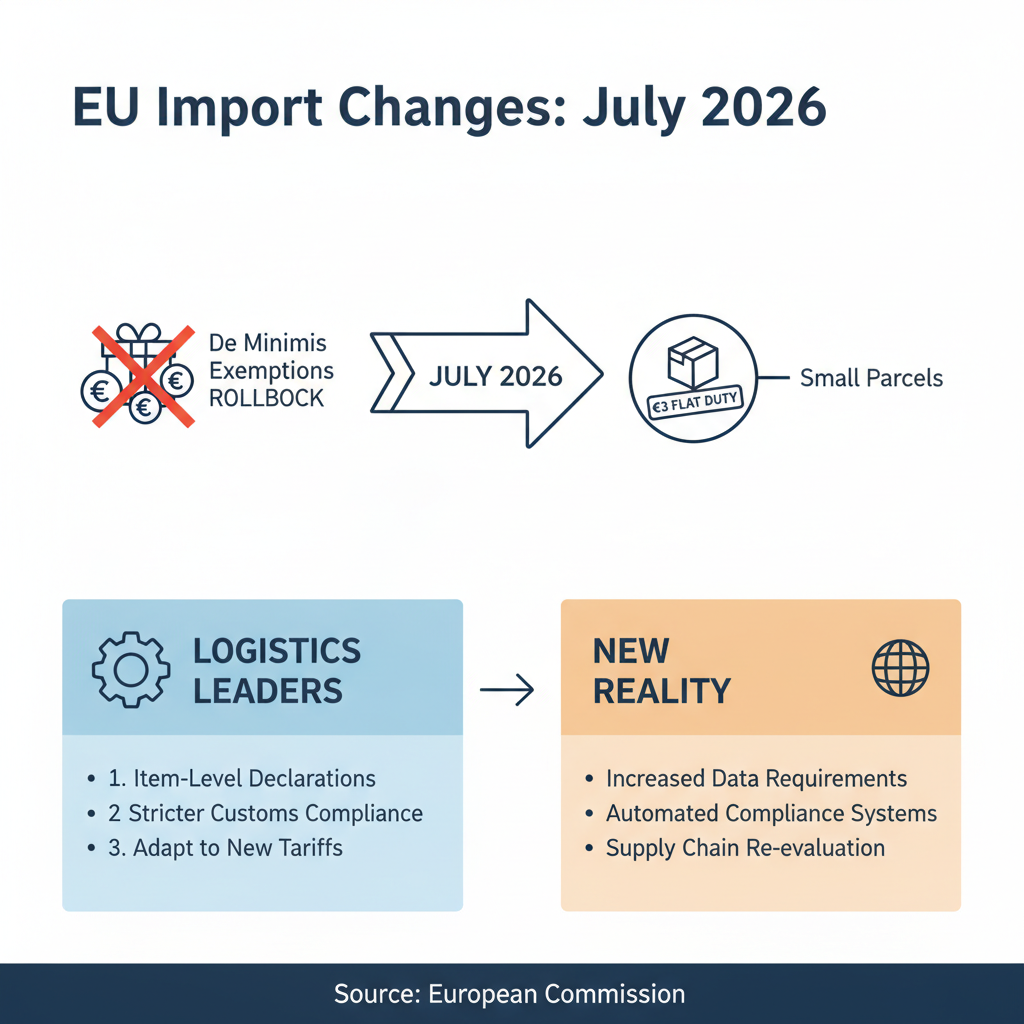
The global logistics landscape faces a structural shift as the European Union abolishes its €150 customs duty exemption for low-value consignments on July 1, 2026. Driven by 5.9 billion low-value items shipped to EU consumers in 2025 without duties, this overhaul addresses safety risks and market fairness. The EU de minimis import exemptions rollback introduces a transitional €3 flat duty per item line for B2C sales until the EU Customs Data Hub launches in 2028. For freight forwarders and fulfillment operators, this signals an era of rigorous compliance.
Logistics providers must adapt to fundamental changes in data management and clearance procedures. The rollback requires item-level customs declarations, replacing consolidated approaches that enabled rapid e-commerce clearance. Operators face the challenge of capturing advanced product data to process the flat-rate duty.
- Item-level declarations: Each unique tariff code in a parcel incurs the €3 duty, increasing processing complexity.
- Destination clearance: Non-IOSS shipments must clear customs in the destination country, not the first entry point.
- Handling fees: Surcharges are expected across member states to cover administrative costs.
To survive the EU de minimis import exemptions rollback, high-volume shippers must modernize IT systems and data workflows. Success requires integration with the Import One-Stop Shop (IOSS) portal and readiness for the 2028 centralized digital customs hub. Logistics leaders who quickly adapt tariff classifications will maintain competitiveness in this new regulatory landscape.
References
Taxation and Customs Union Guidance.
AEB SE Customs Reform Analysis.
EU Exemption Policy Updates.
STAT Times Logistics Report.