
Can Sustainable Aviation Fuel Supply Chains Meet 2026 Demand?
As the aviation industry accelerates its pursuit of net-zero emissions, the development of robust Sustainable Aviation Fuel Supply Chains has become the critical frontier for logistics experts in 2026. Transitioning from traditional jet fuel requires an entirely reimagined logistical network spanning feedstock acquisition, biorefinery placement, and airport distribution channels.
Scaling Feedstock for Sustainable Aviation Fuel Supply Chains
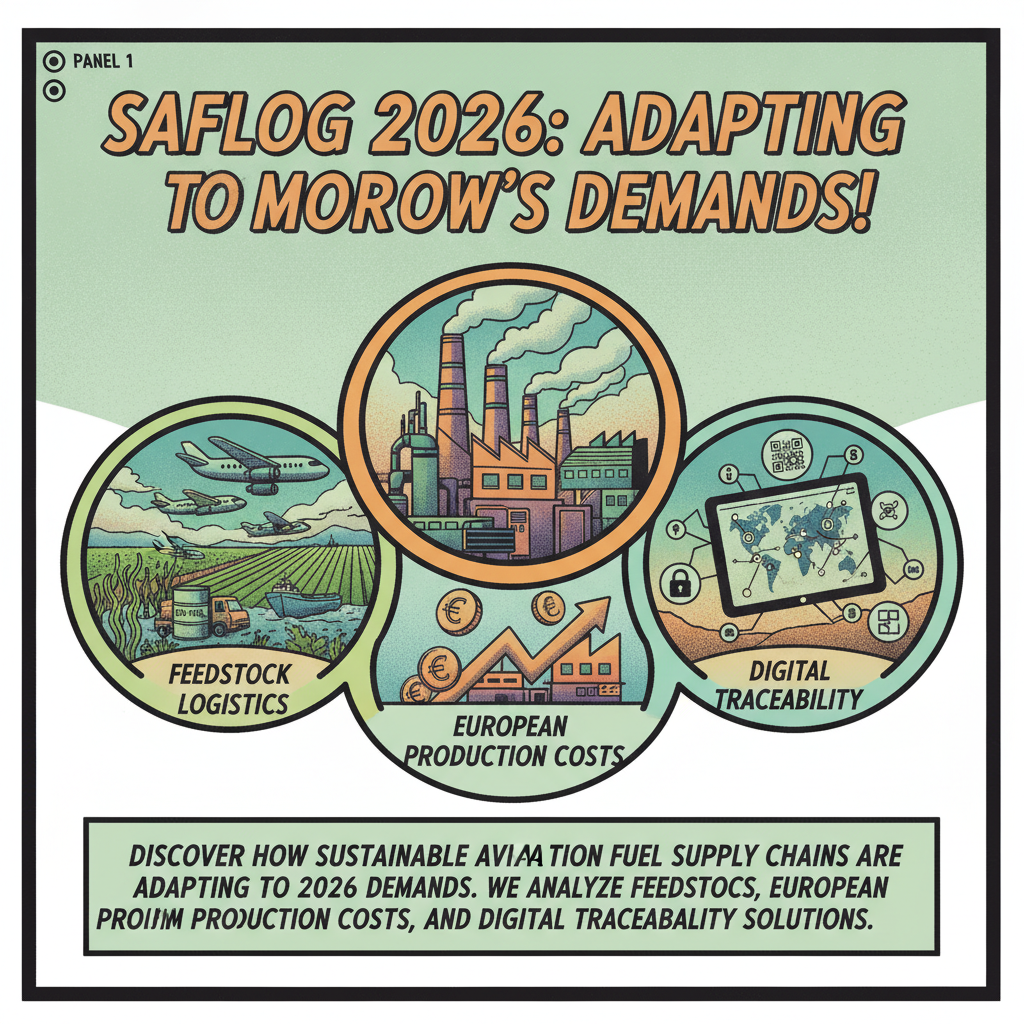
Recent developments in the Asia-Pacific region highlight the massive scale required to operationalize these complex networks. Strategic partnerships are currently targeting the aggregation of 200,000 tonnes of waste feedstock annually across Southeast Asia. To ensure success, logistics professionals are focusing on several key pillars:
- Implementing end-to-end digital traceability systems to meet international compliance standards.
- Establishing regional hubs for processing variable waste feedstocks into sustainable aviation fuel.
- Securing long-term supply agreements directly with airline operators to stabilize spot market volatility.
Furthermore, organizations like the Asia-Pacific Sustainable Aviation Centre are actively researching the economics of Sustainable Aviation Fuel Supply Chains to balance rapid regional growth with strict climate mandates.
Overcoming Costs in Sustainable Aviation Fuel Supply Chains
Despite this strong momentum, significant logistical and cost hurdles remain globally. In Europe, analytical models optimizing CO2 point sources and conversion facilities estimate jet fuel production costs between EUR 1,387 and EUR 1,434 per tonne. This pricing pressure necessitates highly optimized transportation networks. Industry studies reveal that accounting for feedstock variations—such as ash content—can dictate the geographic placement and downsizing of preprocessing facilities. Moving forward, stabilizing Sustainable Aviation Fuel Supply Chains will depend heavily on localized production strategies, robust infrastructure investments, and dynamic routing to combat geopolitical feedstock constraints.
References
[1] GreenAir News (Aug 2026): Asian SAF supply and feedstock deals. [2] Applied Energy (2025): From CO2 emissions to jet fuel. [3] WSU (2026): Alternative Jet Fuel Supply Chain Analysis.