
Shifts in Eurasian Rail Freight Operations
Eurasian Rail Freight Operations are undergoing a major strategic realignment in 2026. Following the Red Sea crisis, normalized maritime shipping costs in 2025 and 2026 have reduced the immediate cost-advantage of overland rail. As a result, shippers are increasingly reserving rail transport for highly time-sensitive or high-value cargo.
The Middle Corridor’s Strategic Expansion
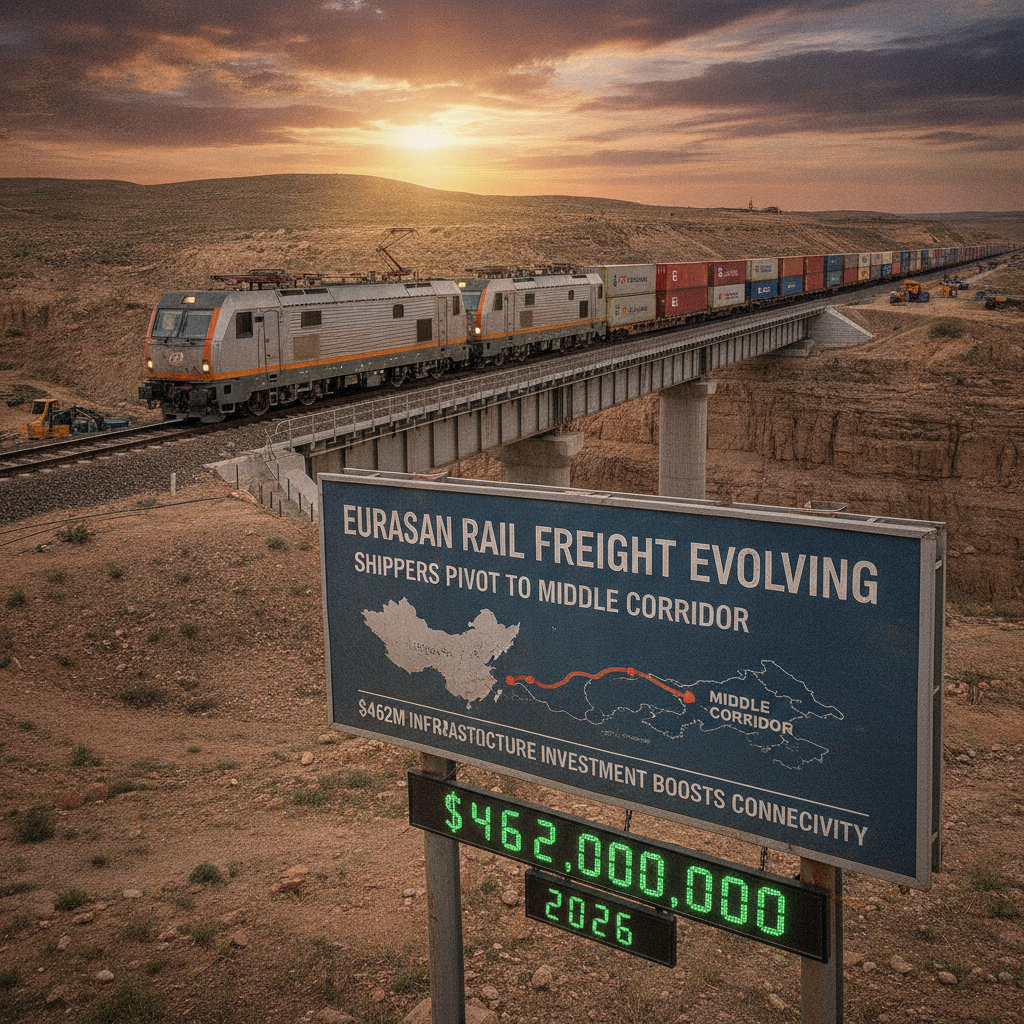
To offset the volume decline on traditional northern routes and mitigate geopolitical risks, stakeholders are aggressively investing in the Trans-Caspian International Transport Route, known as the Middle Corridor. Recent industry data highlights the route’s accelerating adoption:
- In August 2026, European partners and Kazakhstan announced a $462 million package to modernize railway, terminal, and port infrastructure.
- During the first half of 2026, transit hub Azerbaijan transported 7.58 million tons of freight by rail, marking a 6.6% increase compared to 2025.
- New multimodal pilot operations connecting China, Central Asia, and the Caucasus are proving the technical viability of a diversified, polycentric rail network.
Securing Eurasian Rail Freight Operations
While the Middle Corridor currently handles a fraction of maritime volumes, its rapid infrastructural development provides a vital supply chain failsafe. Logistics experts must closely monitor these Eurasian Rail Freight Operations to leverage agile, multi-route strategies in an increasingly volatile global market.