The Emergence of Arctic Ice Silk Road Navigation
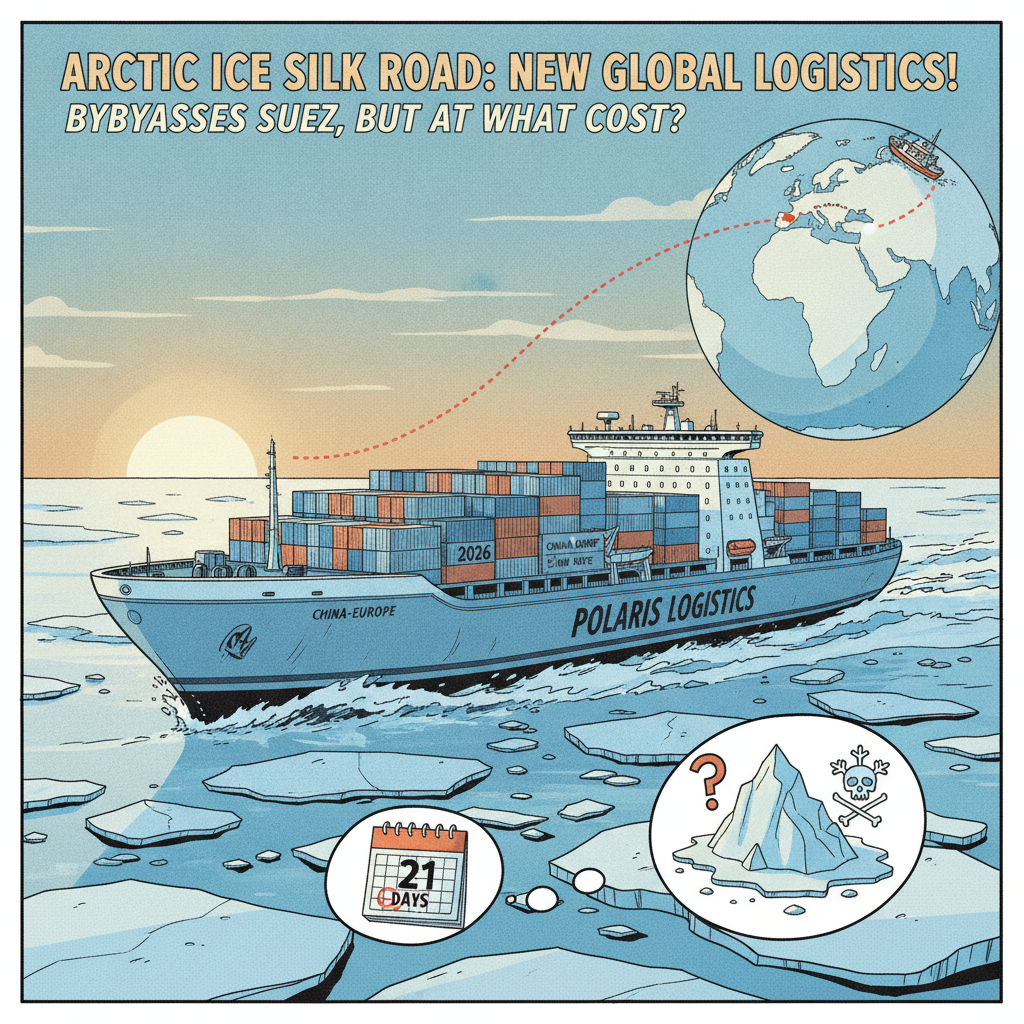
As global supply chains face unprecedented volatility in traditional corridors like the Red Sea and Suez Canal, Arctic Ice Silk Road Navigation is emerging as a critical logistical alternative. In August 2026, Chinese carrier Sea Legend Shipping launched the first regular weekly container service, the China-Europe Arctic Express, significantly testing the commercial viability of the Polar Silk Road. This northern route slashes transit times dramatically, enabling voyages from Ningbo, China, to Felixstowe, UK, in just 20 to 22 days—a sharp contrast to the 40-plus days required via southern routes.
2025-2026 Statistics: A Shift in Global Logistics
Recent data underscores this maritime pivot. By the close of the 2025 navigation season, the Northern Sea Route (NSR) recorded 103 transit voyages and moved an estimated 3.2 million tons of transit cargo. While overall NSR cargo volumes dipped slightly to 37.02 million tons in 2025 due to domestic energy export fluctuations, international transit voyages hit a record high. Key logistical drivers include:
- Speed and Efficiency: Transit times are cut by nearly half, making the route highly attractive for exporting time-sensitive Chinese electric vehicles, lithium batteries, and solar products.
- Bypassing Chokepoints: Arctic Ice Silk Road Navigation avoids geopolitical hotspots, mitigating war risks and surging insurance premiums associated with the Red Sea.
- Expanding Capacities: The 2026 season brings regular commercial schedules for up to eight sailings between August and October.
Opportunities Versus Environmental Realities
Despite its commercial appeal, scaling Arctic Ice Silk Road Navigation faces harsh realities. The operational window remains strictly seasonal, typically restricted to summer and autumn months, and necessitates Russian nuclear icebreaker escorts managed by Rosatom. Furthermore, environmental organizations warn that increased black carbon emissions threaten the fragile Arctic ecosystem. For logistics experts, the route represents a high-reward but complex frontier that requires balancing rapid transit against geopolitical dependencies and ecological responsibilities.