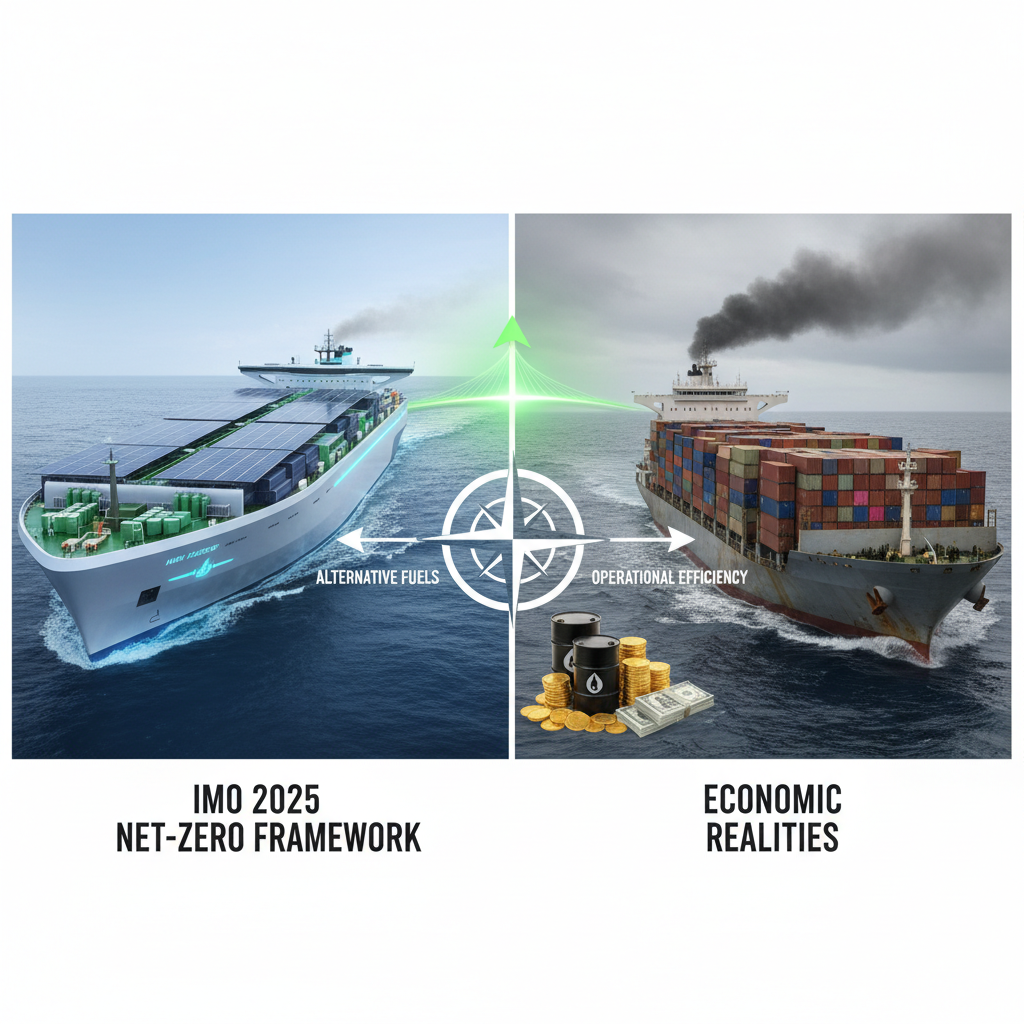
The maritime industry is at a critical crossroads. With international shipping responsible for roughly 3% of global greenhouse gas emissions, the pressure to achieve Maritime Decarbonization has never been higher. In April 2025, the International Maritime Organization (IMO) provisionally endorsed the ambitious Net-Zero Framework, a landmark policy introducing stringent global carbon pricing mechanisms slated for 2028. This framework mandates a 40% emission reduction by 2030 and 70% by 2040, targeting net-zero by mid-century.
Despite regulatory momentum, the economic landscape of Maritime Decarbonization reveals significant friction. According to market projections, the sector is valued at $17.7 billion in 2025 and is expected to surge to $44.31 billion by 2035, reflecting a 9.61% CAGR. However, a recent April 2026 industry survey indicates a marked decline in carriers’ willingness to pay premium rates for low-carbon fuels. Geopolitical volatility, economic uncertainty, and high costs of zero-emission fuels remain formidable barriers.
To navigate these headwinds, logistics experts must adopt multi-faceted decarbonization strategies:
- Operational Efficiency: Analyses suggest energy-saving measures, such as slow steaming, could account for up to 50% of the required emissions reductions by 2030.
- Alternative Fuels: Scalable zero-emission fuels, including e-methanol and hydrogen-derived ammonia, are essential for long-term compliance.
- Infrastructure Investment: Blended finance vehicles and port upgrades are vital to supporting global regulations.
While the long-term value of green shipping persists, operators must balance immediate regulatory compliance with sustainable economic strategies.
References
Boston Consulting Group. Demand for Low-Carbon Shipping Has Fallen. April 2026. | Market Research Future. Maritime Decarbonization Market Forecast 2035. May 2026. | Cleantech Group. From 2025 Funds to 2026 Futures. March 2026. | BCG. Energy-Efficient Route to Maritime Decarbonization. Aug 2025. | SCIRP. IMO Net-Zero Framework. 2025. | Accelleron. Finding the fuels to save shipping decarbonization goals. Nov 2025. | Columbia University SIPA. Practical Gaps in the IMO Net-Zero Framework. Oct 2025.