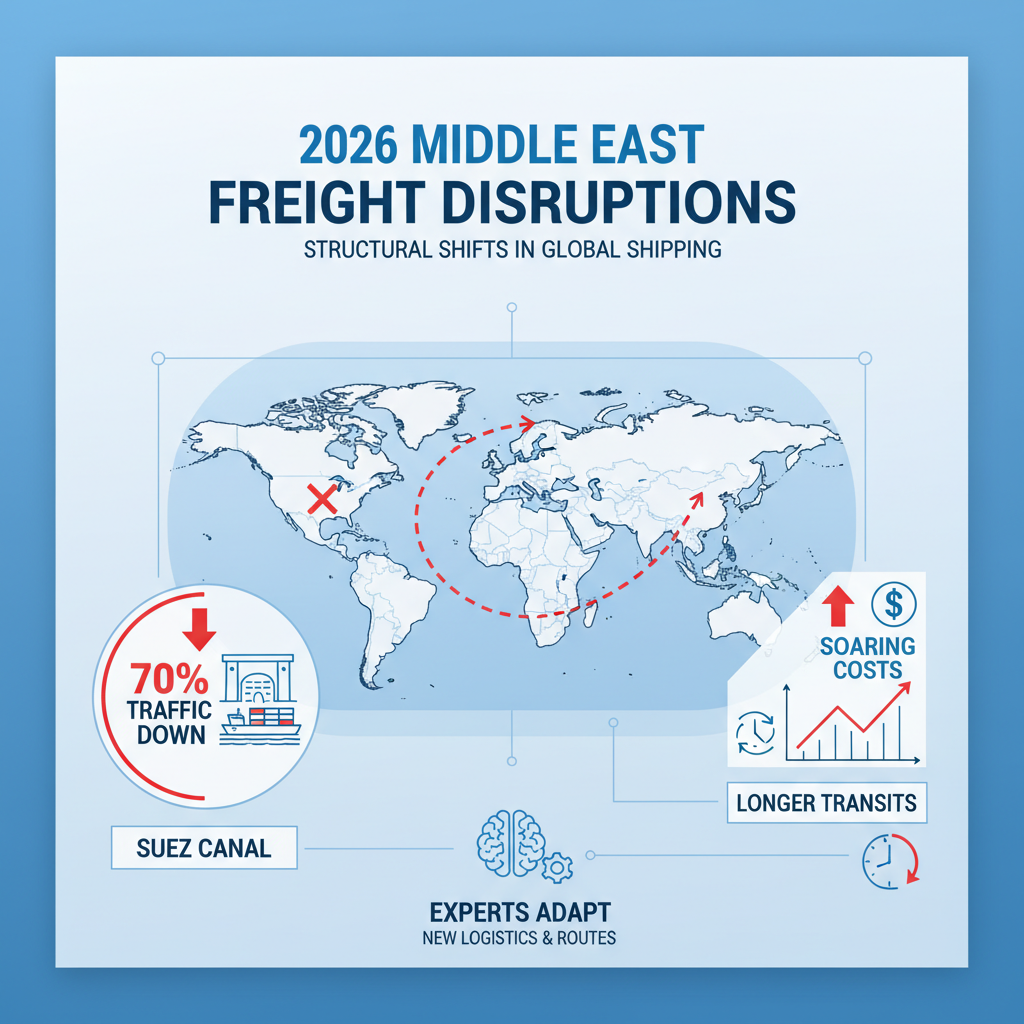
The prolonged geopolitical volatility across the Red Sea and Strait of Hormuz has transformed Middle East Freight Disruptions into a structural baseline for 2026. Major corridors remain restricted, with Suez Canal traffic plummeting 70% as carriers permanently integrate the Cape of Good Hope detour. This diversion adds up to 14 days in transit and roughly $1 million in costs per voyage. Consequently, transpacific freight rates have escalated 40% above pre-crisis levels.
Industry leaders are grappling with staggering financial impacts. Maersk reports paying nearly $500 million monthly in extra fuel costs, while Hapag-Lloyd absorbs up to $300 million. Furthermore, instability in the Strait of Hormuz temporarily slashed vessel traffic by 70%, exacerbating global capacity crunches.
- Transit Delays: Rerouting adds up to two weeks for Asia-Europe corridors.
- Capacity Constraints: Extended voyages have removed 15% to 20% of global shipping capacity.
Navigating ongoing Middle East Freight Disruptions requires agile procurement. Logistics experts must proactively integrate AI-driven predictive analytics and explore multimodal alternatives like China-Europe rail corridors. Shippers must abandon just-in-time inventory in favor of strategic buffering, as regional congestion remains embedded in global supply chains.
References
- Kalkine: El Nino Is Back, 2026
- ArcGIS: Red Sea Shipping Disruptions
- IRE Journals: Impact of Red Sea Crisis
- Logistics Business: Middle East Shipping Disruption
- Lloyd’s List: Hormuz Crisis Rates
- Automotive Logistics: Iran Conflict Supply Chains