
In the first half of 2026, the logistics sector is navigating a pronounced Americas and Europe ocean freight rate divergence. Rather than tracking a unified global cycle, container spot prices are increasingly dictated by lane-specific operational risks, distinct regional economic conditions, and shifting inventory strategies.
Recent data from May 2026 highlights this widening gap. While Asia-U.S. West Coast prices saw moderate growth reaching $2,828 per forty-foot equivalent unit (FEU) and East Coast rates hovered near $4,340, the Asia-Europe lanes demonstrated different volatility. Asia-North Europe spot rates recently jumped 10% to $2,850 per FEU, yet they remain susceptible to rapid corrections as carriers struggle to match capacity with inconsistent consumer demand.
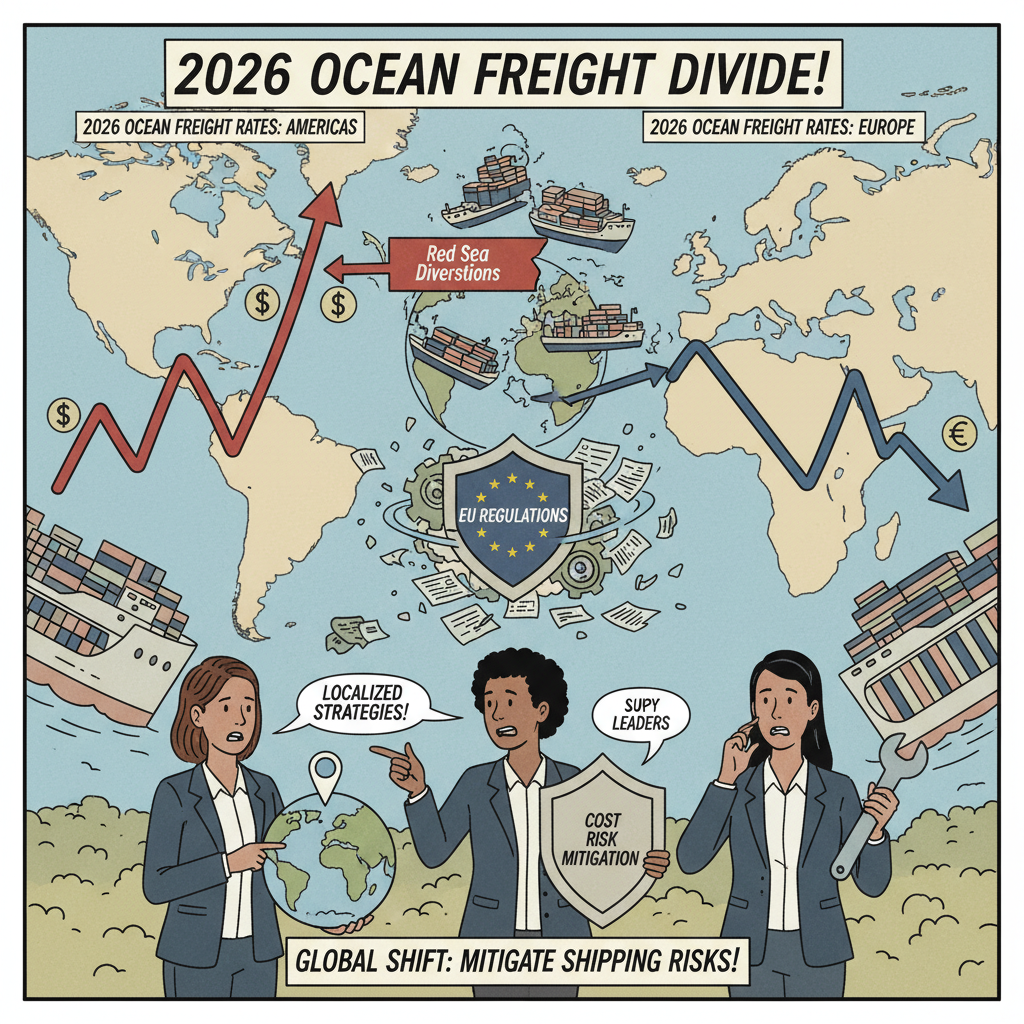
Several systemic factors are fueling the current Americas and Europe ocean freight rate divergence. The prolonged Red Sea disruptions have unevenly burdened European trade, forcing Asia-Europe vessels into lengthy Cape of Good Hope diversions that push transit times beyond 50 days. Meanwhile, trans-Pacific routes face distinct hurdles, primarily front-loading cargo demand driven by anticipated U.S. tariff policy shifts.
Additionally, localized regulatory costs are splitting the market. The European Union Emissions Trading System (EU ETS) is imposing strict environmental compliance costs on European maritime transport, creating a regional pricing baseline not shared by American destinations.
Supply chain leaders must pivot to lane-specific tactics to mitigate these diverging costs:
- Consider sea-air hybrid solutions for European freight where extended ocean transits are commercially unviable.
- Monitor U.S. import front-loading trends that could artificially constrain trans-Pacific capacity.
- Prepare for carrier capacity manipulation, such as blanked sailings designed to prop up spot rates during low-demand windows.
The era of globally synchronized shipping rates is over. To maintain profitability in 2026, shippers must analyze the Americas and Europe as distinctly separate operational theaters.
References
1. Metro Global: Peak season uncertainty grows as freight demand diverges (May 2026). https://metroglobal.com
2. FreightWaves: Trans-Pacific ocean rates remain above pre-war levels (May 2026). https://freightwaves.com
3. Cello Square: Why are ocean freight rates declining in 2025/2026? (Oct 2025). https://cello-square.com