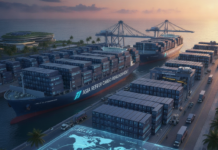


The era of treating Asia solely as the world’s factory has officially ended, giving way to a new era of Intra-Asia supply chain regionalization. According to industry analyses, this corridor now moves a staggering monthly average of 3.95 million TEUs, officially surpassing the combined container volume shipped from the Far East to North America and Europe. Furthermore, late 2025 metrics from UPS highlighted that Intra-Asia growth led global regional demand at a surging 15.8 percent. This transformative Intra-Asia supply chain regionalization is reshaping how logistics professionals manage freight, as the World Economic Forum’s 2026 Trade Pulse Report confirms that intra-regional trade has eclipsed trans-Atlantic flows for the first time in history.
Several converging factors are accelerating this profound market realignment in 2026:
- Geopolitical Risk Mitigation: Ongoing trade frictions and tariff barriers are forcing businesses to adopt friend-shoring and multi-hub manufacturing, redistributing operations from China to emerging hubs like Vietnam, Indonesia, and the Philippines.
- Economic Interdependence: Deepening agreements like the Regional Comprehensive Economic Partnership (RCEP) and CAFTA 3.0 are slashing tariffs and formalizing a closed-loop Asian economic ecosystem.
- Rising Local Consumption: A booming middle class and rapid cross-border e-commerce expansion mean that semi-finished and finished goods increasingly stay within Asian borders.
Despite its massive growth, Intra-Asia supply chain regionalization presents distinct challenges. The logistics landscape remains highly fragmented and vulnerable to extreme spot rate volatility. Market intelligence from Xeneta indicates that neighboring trade lanes, such as Shanghai to Singapore and Tanjung Pelepas, have experienced severe freight rate spikes and decoupling. Simultaneously, the 2026 shipping market faces an ocean paradox. While a record influx of nearly 10 million TEU in new vessel capacity promises to lower base rates, carriers are actively protecting revenues through blank sailings, inherently reducing schedule reliability and straining inland networks. To survive, forwarders and shippers must pivot toward diversified vendor bases, AI-driven dynamic routing, and localized digital logistics platforms.
References
Xeneta: xeneta.com Vantage Logistics: vantage-logistics.com.vn Maersk: maersk.com DHL: dhl.com Trade Pulse 2026 via Medium Maersk YouTube Insights UPS Supply Chain Solutions 2026 Q1 Tradlinx 2026 Shipping Market Outlook.