
How Pan-Asian Trade Route Development Is Reshaping 2026 Logistics
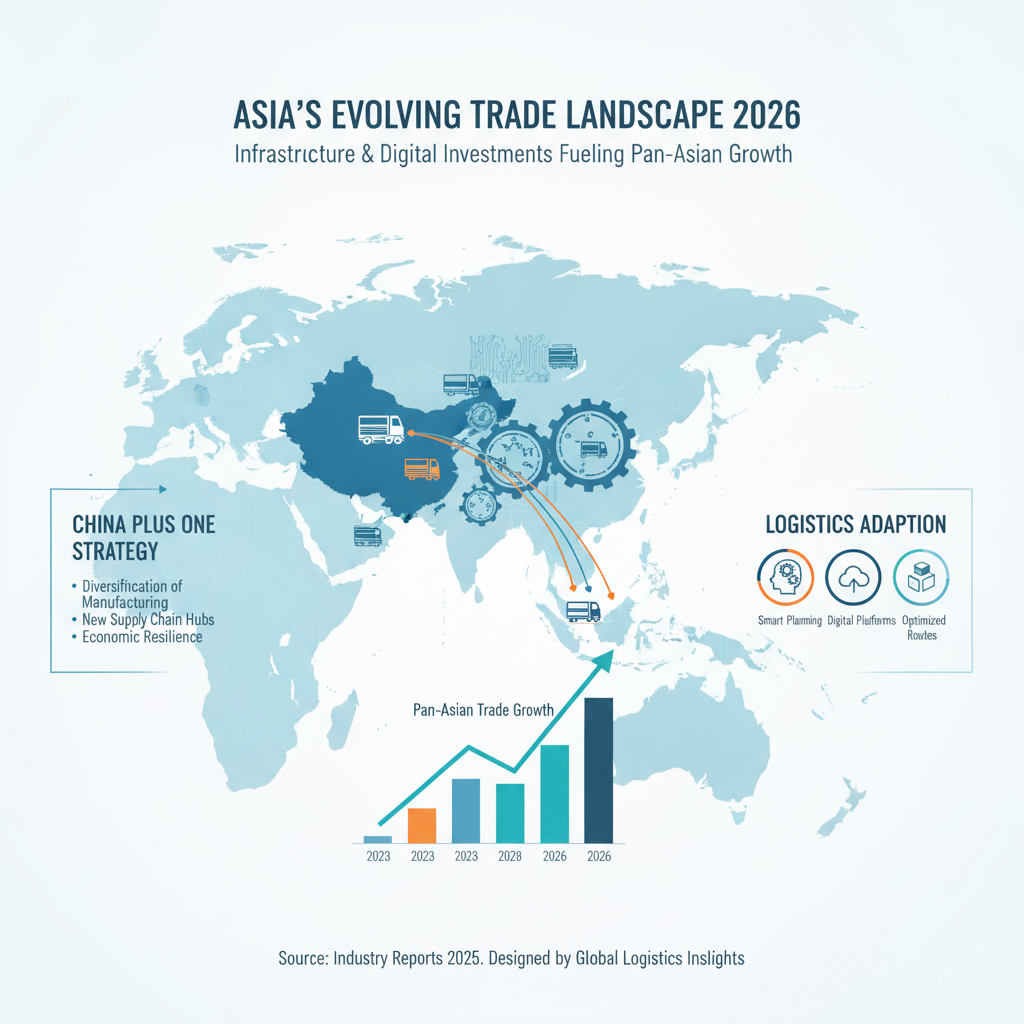
The global supply chain is undergoing a seismic shift, with Pan-Asian Trade Route Development taking center stage in 2026. Driven by the China Plus One manufacturing strategy, intra-Asian trade networks are experiencing unprecedented growth and structural realignment. As regional integration deepens, logistics experts must navigate new infrastructure investments, digital transformations, and emerging capacity demands.
Surging Capacity in Pan-Asian Trade Route Development
Recent data underscores the massive scale of regional redirection. In the first half of 2026, container shipping capacity on intra-Asia routes surged by 15.8% year-on-year, nearly doubling the 8.2% growth rate seen on global deep-sea routes. This Pan-Asian Trade Route Development reflects long-term capital reallocation by major carriers rather than short-term fluctuations. The Asia-Pacific sea freight forwarding market itself was valued at USD 21.09 billion in 2024 and is projected to reach USD 25.14 billion by 2032.
Key Drivers of Pan-Asian Trade Route Development
Logistics professionals are capitalizing on several core trends reshaping the region:
- Infrastructure Upgrades: Southeast Asia is seeing massive capital injection, yet a $60 billion investment gap remains between current infrastructure plans and future trade demands. Critical upgrades include Vietnam’s Cai Mep-Thi Vai deep-sea port and expanded cross-border rail lines.
- Digital Integration: The adoption of blockchain-based customs documentation and AI-driven route optimization is streamlining complex multi-country logistics networks.
- Manufacturing Shifts: Vietnam and Indonesia are leading the absorption of foreign direct investment, recording $16 billion and $33 billion in greenfield manufacturing respectively in recent years.
Strategic Implications for 2026
As Pan-Asian Trade Route Development matures, the focus is shifting toward supply chain resilience and green trade facilitation. For shipping and logistics experts, prioritizing agile, tech-enabled multimodal solutions will be paramount to capturing growth in these rapidly evolving corridors. To remain competitive, supply chain leaders must continually reassess their regional port dependencies and invest heavily in digital visibility tools.