The May 2026 Quad Foreign Ministers’ Meeting in New Delhi marked a pivotal shift for Indo-Pacific supply chains, spotlighting Quad Port Infrastructure Investments as a critical tool for regional stability. With nearly 60% of global maritime trade traversing the Indo-Pacific, securing resilient maritime corridors has become a top priority for the United States, India, Japan, and Australia.
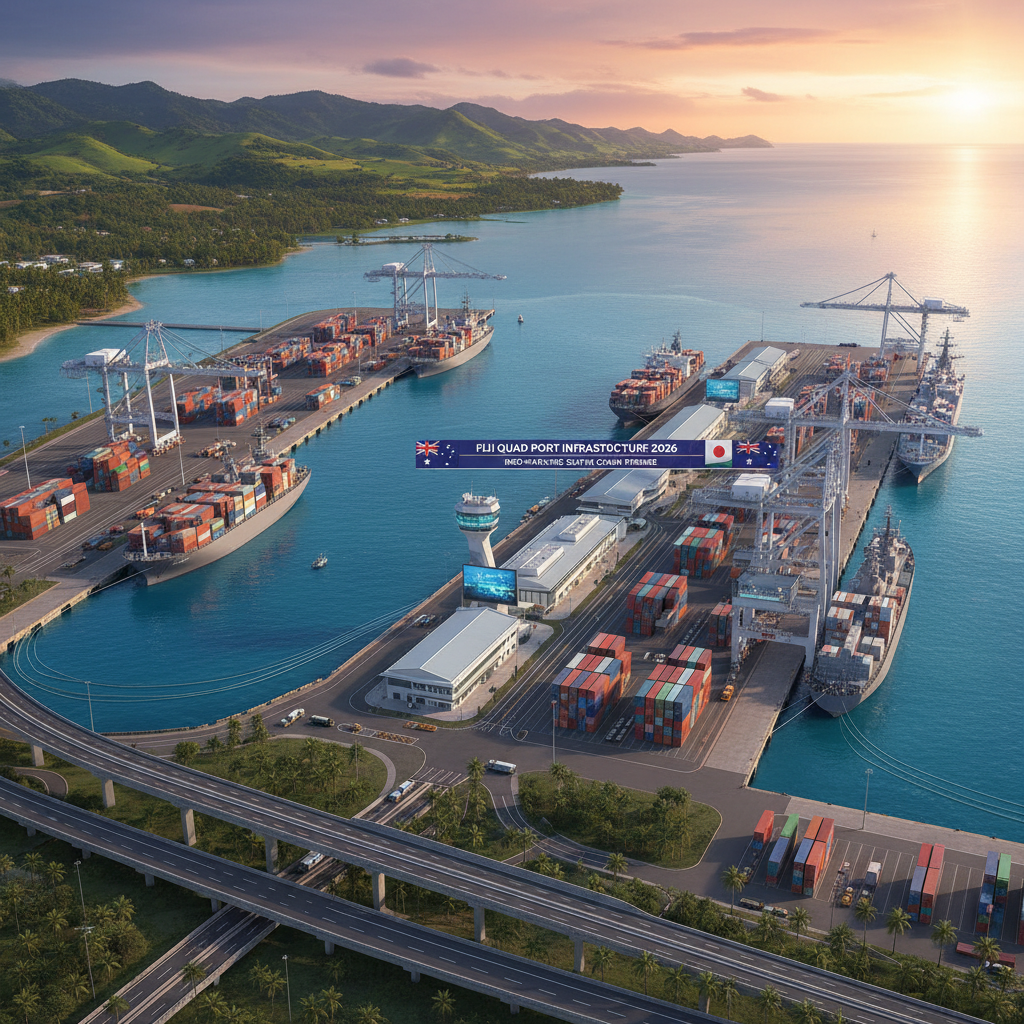
The cornerstone of this new geoeconomic strategy is the first-ever joint port development project in Fiji, operating under the Ports of the Future Partnership. Following the foundational October 2025 Quad Ports conference in Mumbai, this initiative directly addresses Pacific Island capacity shortages while offering an alternative to monopolized supply chains. Logistics experts note that Fiji serves as a natural maritime convergence point for Oceania, making it a critical hub for commercial shipping and regional logistics.
For shipping and logistics professionals, these Quad Port Infrastructure Investments signal several major industry shifts:
- Enhanced Maritime Domain Awareness: Integration of regional monitoring to track commercial shipping and secure strategic sea lanes.
- Supply Chain Diversification: New funding pathways for high-quality, transparent port facilities that mitigate reliance on singular regional powers.
- Energy and Trade Resilience: Infrastructure upgrades designed to maintain open, unimpeded commerce amid global chokepoint uncertainties.
As these strategic investments materialize, logistics operators must prepare for a newly optimized, resilient Indo-Pacific maritime network.
References
Republic World, “Amid Strait Of Hormuz Crisis, QUAD Unveils Big Indo-Pacific Surveillance Plan” (May 2026). Defense News, “Quad nations step up Indo-Pacific push with new initiatives” (May 2026). Radio Free Asia, “Quad’s Fiji port plan will challenge China’s Pacific supply-chain dominance” (May 2026). Ananta Centre, “PORT CON 2025” (2025). Shankar IAS Parliament, “QUAD Mains Analysis” (June 2026).