Current State of the Alternative Marine Fuels Orderbook
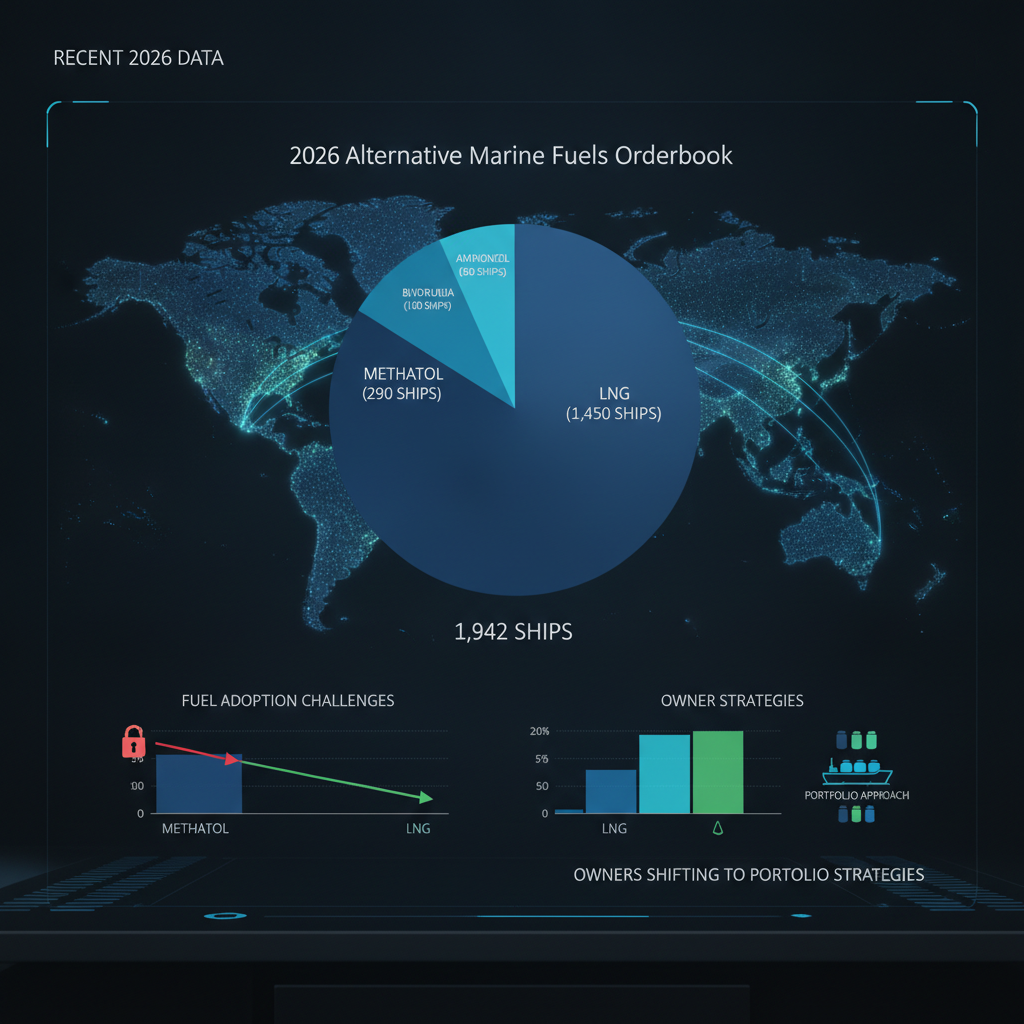
In 2025 and early 2026, the shipping industry navigated regulatory uncertainty, yet the push for decarbonization remained resilient. According to recent data from Lloyd’s Register, the total alternative marine fuels orderbook now stands at 1,942 ships. Despite a broader 47% year-on-year drop in overall newbuild contracting in 2025, alternative-fuel vessels maintained a robust presence, capturing 38% of the total ordered gross tonnage.
LNG’s Dominance in the Alternative Marine Fuels Orderbook
Liquefied Natural Gas (LNG) continues to be the dominant transition fuel. DNV statistics reveal that LNG leads the current mix, particularly in the container segment where it accounts for 58% of the alternative fuel tonnage. The current pipeline includes 1,259 LNG-capable ships compared to 385 methanol-capable vessels. The recent slowdown in methanol orders, which fell to 61 from 149 in the previous year, is largely attributed to ongoing infrastructure bottlenecks and scarcity in green methanol production.
A Portfolio Approach for 2026 and Beyond
Emerging zero-carbon options are slowly gaining traction, with the alternative marine fuels orderbook currently featuring 53 hydrogen-capable and 45 ammonia-capable vessels. DNV analysts note that shipowners in 2026 are treating fuel choice as a portfolio decision rather than a single bet, managing optionality to mitigate risks of stranded assets amidst divergent regulatory regimes. However, to meet the International Maritime Organization’s 2030 zero-emission targets, industry experts warn that contracting for next-generation fuels must accelerate rapidly.
References
- Lloyd’s Register: Alternative-fuelled ship orders remain significant in 2025
- DNV: LNG-fuelled container ships sustain alternative fuel share of global orderbook amid industry slowdown
- Seatrade Maritime News: Alternative fuels hold firm in 2025 orderbook slowdown
- gCaptain: Alternative Fuel Vessel Orders Slow in 2025 Despite Strong LNG Demand
- Maritime Executive: Uncertainty and Diverse Approach Slow Orders for Alternative Fuel Vessels