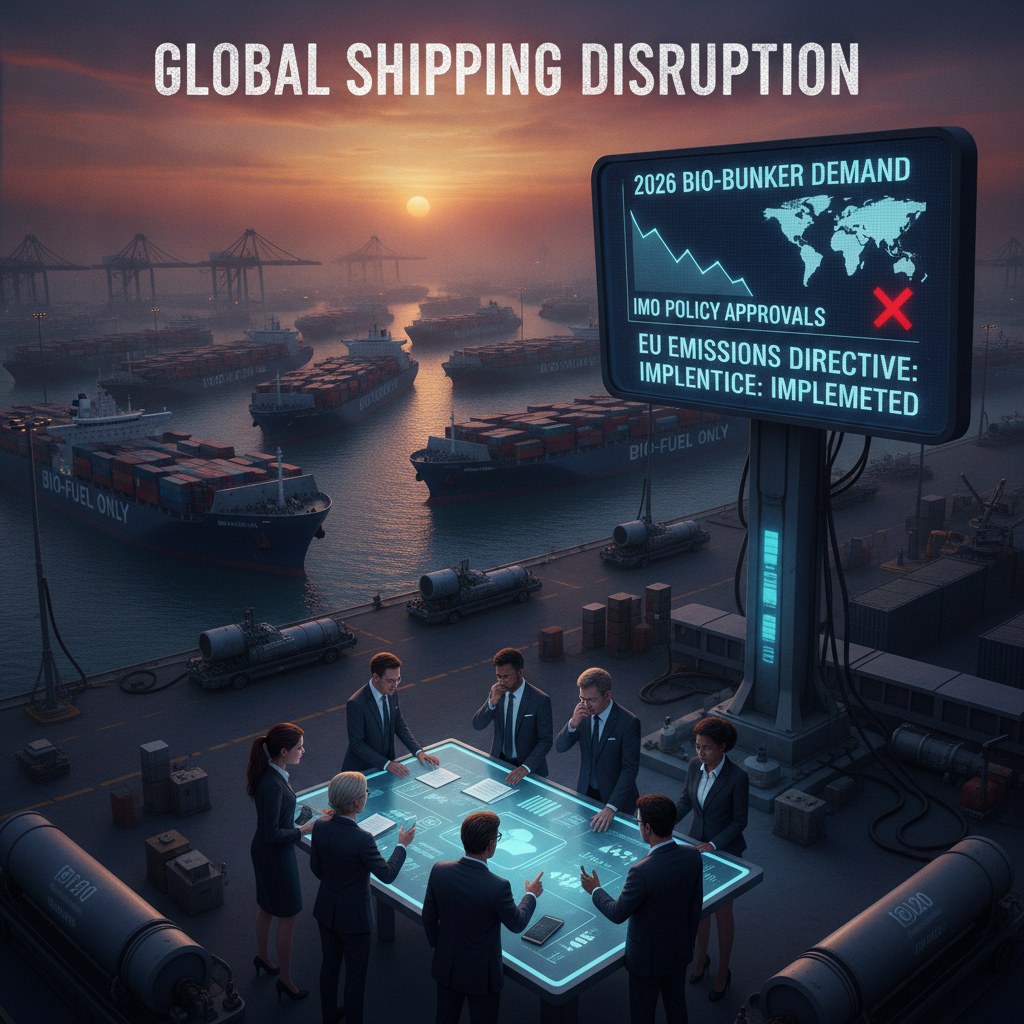
The maritime industry is facing a notable bio-bunker demand slowdown in 2026, challenging logistics experts navigating decarbonization mandates. After explosive growth since 2022, preliminary data from the Maritime and Port Authority of Singapore (MPA) revealed a stark 46.6% year-on-year drop in biofuel blend demand to 62,200 tonnes by late 2025. This pivot stems heavily from regulatory uncertainty and shifting geopolitical tides.
Industry analysts attribute this stagnation to several converging factors affecting global shipping lanes:
- Regulatory uncertainty following the International Maritime Organization’s (IMO) recent deferment of its proposed Net Zero Framework (NZF).
- The implementation of the EU’s stricter Renewable Energy Directive (RED III), which restricts key waste-based biofuels and raises compliance costs.
- Economic pressures, as bio-bunker fuels traditionally maintain a premium of up to 40% over conventional crude oil-based marine fuels.
While the bio-bunker demand slowdown persists, shipping companies must pivot their compliance strategies. Experts indicate that trading of Used Cooking Oil Methyl Ester (UCOME) blends has decelerated due to anticipated tighter sustainability standards. Logistics fleets are increasingly evaluating alternative low-emission pathways, leveraging situational arbitrage against FuelEU compliance pricing, or exploring LNG transitional options. Successfully weathering this bio-bunker demand slowdown requires robust forecasting, regulatory agility, and diversified alternative fuel portfolios.
References
Argus Media – Viewpoint: Asia’s shipping faces uncertainty in 2026
Argus Media – Viewpoint: Asia’s shipping faces uncertainty in 2026
S&P Global – Decarbonization and development: Logistics network investments