
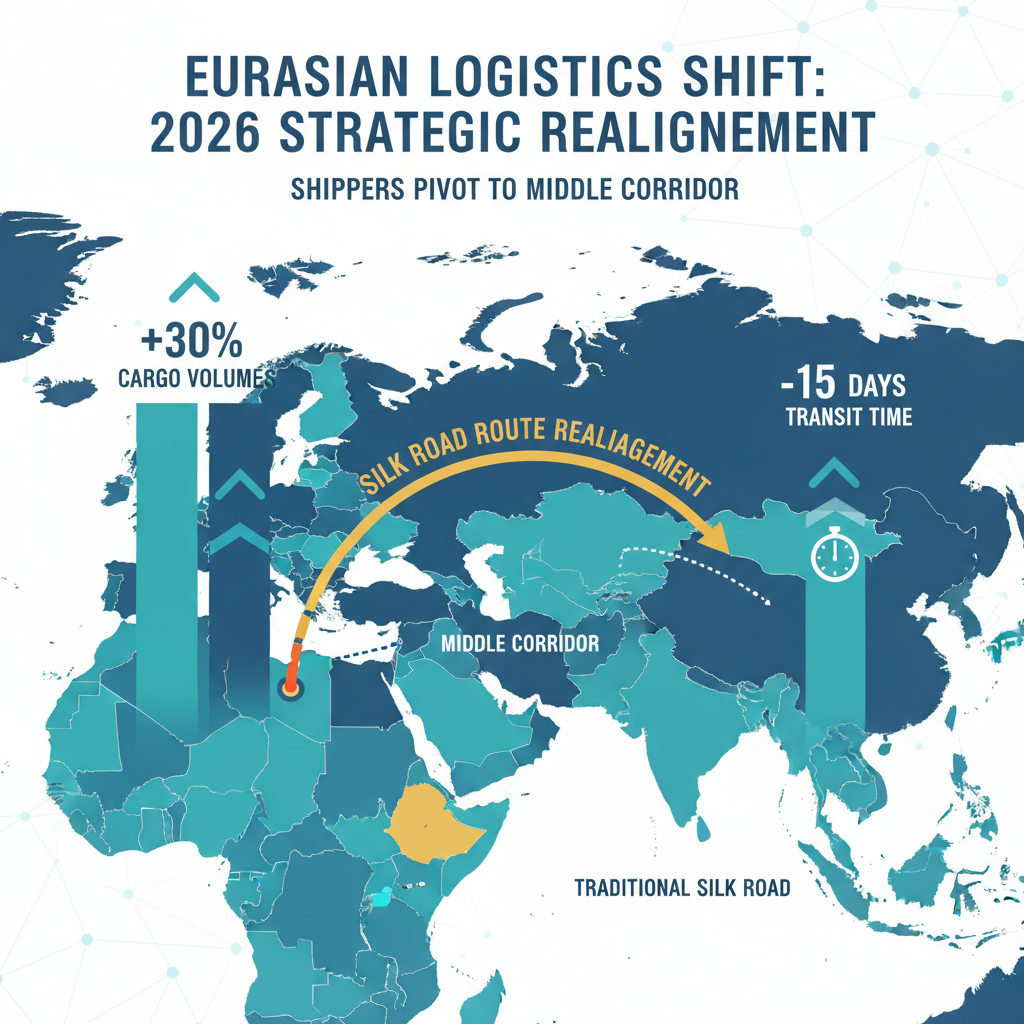
The global logistics landscape is undergoing a massive transformation, driven by geopolitical tensions and supply chain vulnerabilities. At the center of this shift is the Silk Road Route Realignment, primarily focusing on the Middle Corridor, or the Trans-Caspian International Transport Route (TITR). Bypassing traditional Russian and Iranian territories, this route connects China and Europe via Central Asia, the Caspian Sea, and the South Caucasus.
Recent data underscores the urgency and scale of this transition. For logistics experts, the realignment presents both unprecedented opportunities and infrastructural challenges.
- Surging Cargo Volumes: Freight along the TITR reached 4.48 million tons in 2024 and maintained strong momentum with 4.12 million tons in 2025.
- Enhanced Efficiency: Strategic investments and customs digitalization have successfully slashed transit times from 28-32 days down to just 13-17 days.
- Ambitious Targets: Kazakhstan recently set a mandate to increase total national transit volumes to 55 million tons by 2026, directly supporting the corridor’s expansion.
Despite impressive growth rates, the Silk Road Route Realignment requires massive infrastructure upgrades to remain competitive against cheaper maritime alternatives. Capacity at key Caspian hubs, such as the ports of Kuryk and Aktau, is currently being expanded through extensive dredging and modernization projects. As foreign direct investment pours into Central Asia from multilateral institutions like the World Bank and the EBRD, the success of this multimodal artery will depend on sustained cross-border cooperation and digital integration.
References
- Carnegie Politika: The Much-Touted Middle Corridor Transport Route Could Prove a Dead End
- Oxford Business Group: The Trans-Caspian International Transport Route
- Astana Times: Trans-Caspian Transport Route Cargo Volumes Increase Fivefold
- Carnegie Politika: The Middle Corridor
- EY in Kazakhstan: Trans-Caspian International Transport Route
- The Times of Central Asia: Kazakhstan Pushes Middle Corridor