
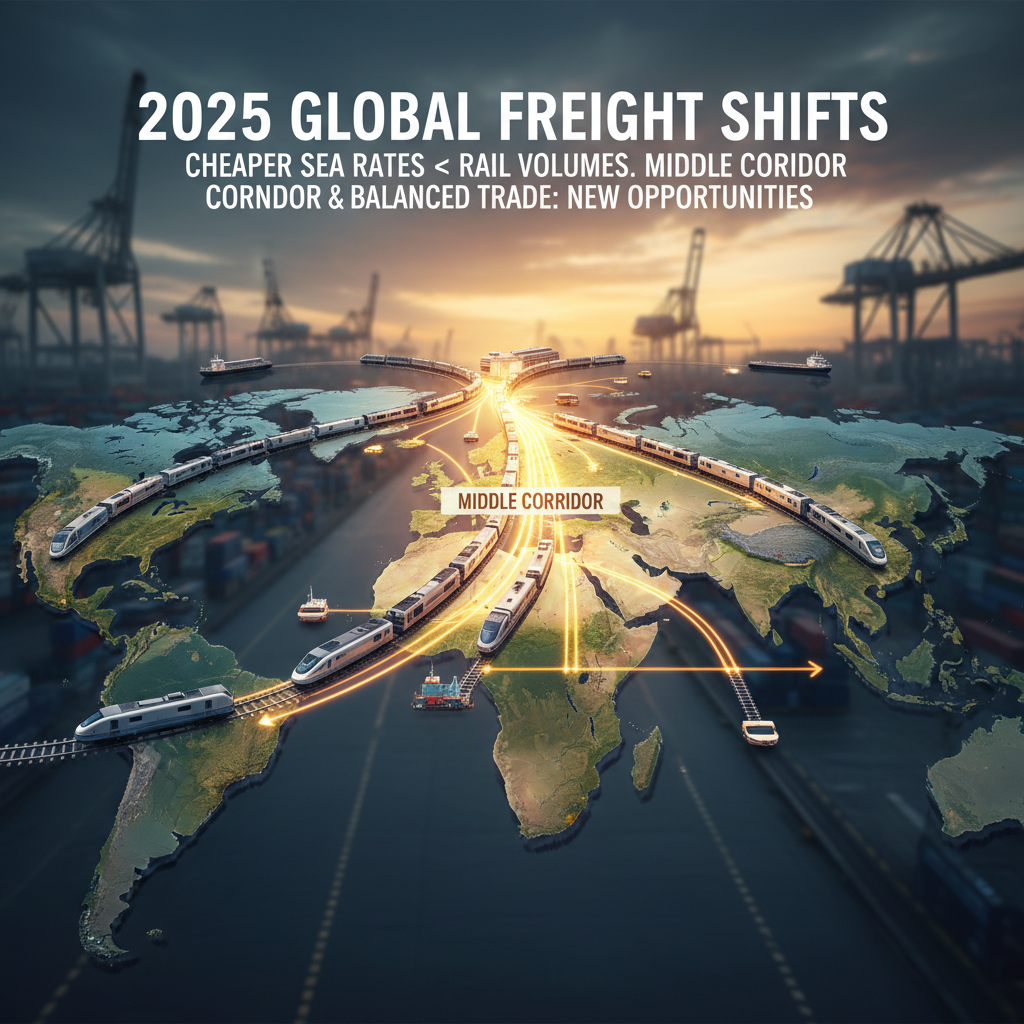
Eurasian rail freight trends are undergoing a critical transformation driven by shifting multimodal cost dynamics and geopolitical normalizations. In 2025, total container traffic along core Eurasian rail routes saw a notable contraction, falling to 572,300 TEU from 745,900 TEU the previous year. This decline highlights a pressing reality for logistics experts: normalized maritime freight rates are aggressively pulling cargo back to the sea.
While 2024 saw rail freight benefit from Red Sea disruptions, 2025 and 2026 present a drastically different landscape. By late 2025, shipping a container from Shanghai to Rotterdam by sea dropped to roughly $2,150 to $2,600 per FEU. In contrast, the rail equivalent remained stable but considerably higher at $5,600 to $6,600 per FEU. Although rail maintains an advantage in transit speed and price stability, this widened cost gap has made ocean transport the preferred option for cost-sensitive shippers.
Despite top-level volume drops, the structural foundation of Eurasian rail logistics is evolving rapidly:
- Rise of the Middle Corridor: The Trans-Caspian International Transport Route is experiencing robust growth, with container traffic surging by 37 percent in early 2025.
- Rebalanced Flows: For the first time in recent years, return services heading towards China exceeded outbound trains from China, signaling a major shift in trade balances.
- Diversification of Goods: Traditional anchor cargoes like electronics and automotive equipment lost volume share, pushing rail operators to attract new commodity types.
For supply chain professionals, leveraging these Eurasian rail freight trends means balancing the premium cost of rail against its reliability in an unpredictable global market.
References
- Trans.INFO – Cheaper sea freight pulled cargo off Eurasian rail in 2025
- Latest Railway News – Return flows overtake outbound China-Europe rail
- Trans.INFO – Eurasian rail report 2025
- Railway PRO – Middle multimodal Corridor showing rapidly growing potential