
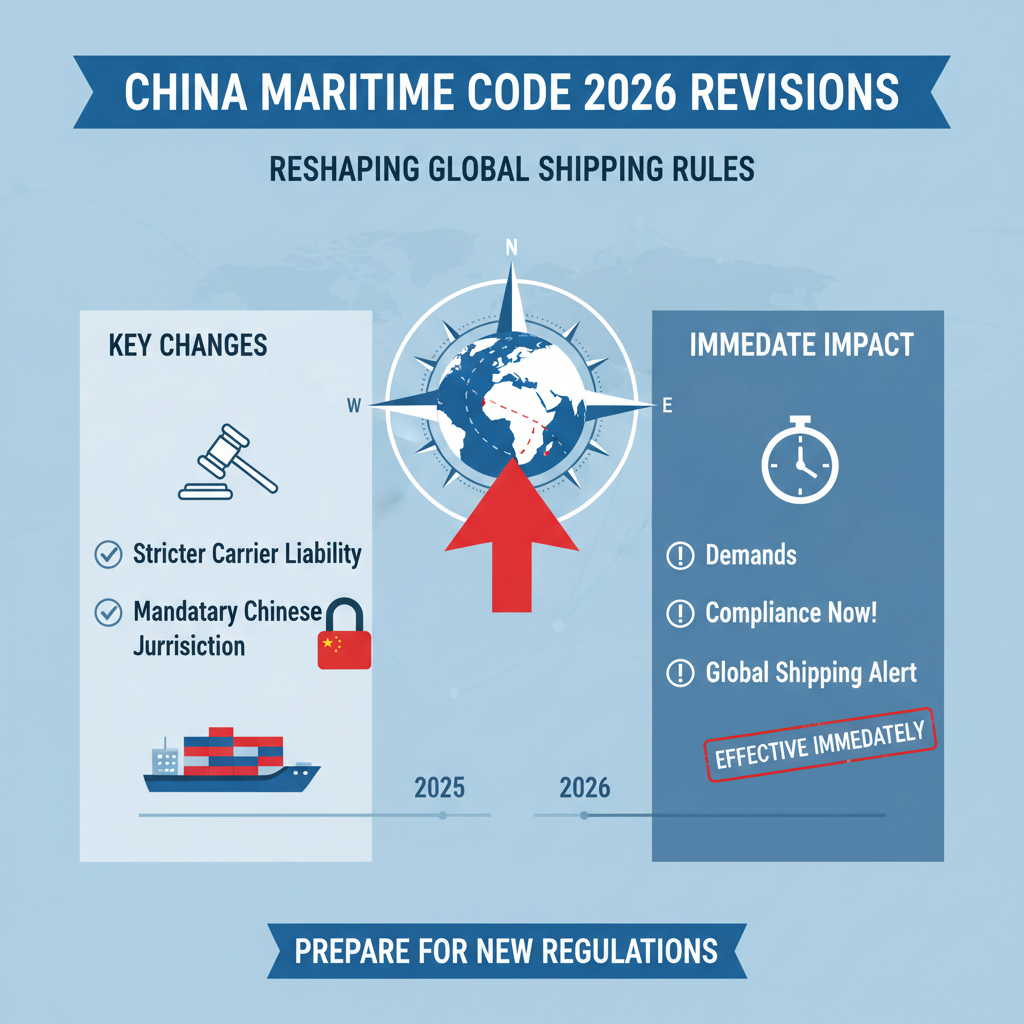
The China Maritime Code 2026 revisions mark the most significant overhaul of Chinese maritime law since its inception in 1993. Enacted on May 1, 2026, the updated framework radically alters liability and compliance mandates for logistics operators globally.
Perhaps the most disruptive change lies in Article 295. This mandate dictates that any international carriage contract where the loading or discharge port is located within China must be governed by Chapter IV of the revised Code. Consequently, standard choice-of-law clauses—such as those designating English law—are now overridden by Chinese jurisdiction for relevant disputes.
Beyond jurisdictional shifts, the China Maritime Code 2026 revisions introduce critical operational realities that carriers and forwarders must immediately address. Key updates include:
- Expanded Carrier Obligations: Responsibilities now extend beyond the traditional Hague-Visby tackle-to-tackle parameters, explicitly adding receipt and delivery to the carrier’s burden of proof.
- Unclaimed Cargo Risks: The costs and risks associated with non-delivery at discharge ports have been formally shifted from the consignee to the shipper.
- Digitalization and Liability Caps: The new law grants formal legal standing to electronic transport records and significantly increases liability limits to align with the 1996 LLMC Protocol.
Logistics professionals must audit standard contract terms and update claims-handling timelines. Waiting for a dispute to arise under the China Maritime Code 2026 revisions will result in massive exposure gaps for unprepared entities. Industry experts strongly recommend reviewing bills of lading and ensuring operational protocols reflect these newly active standards immediately.
References
- Globallawexperts.com: China Maritime Code 2026 Changes (globallawexperts.com)
- Ashurst: Revised PRC Maritime Code Article 295 (ashurst.com)
- Japan P&I Club: Key Revisions of the Maritime Code (piclub.or.jp)