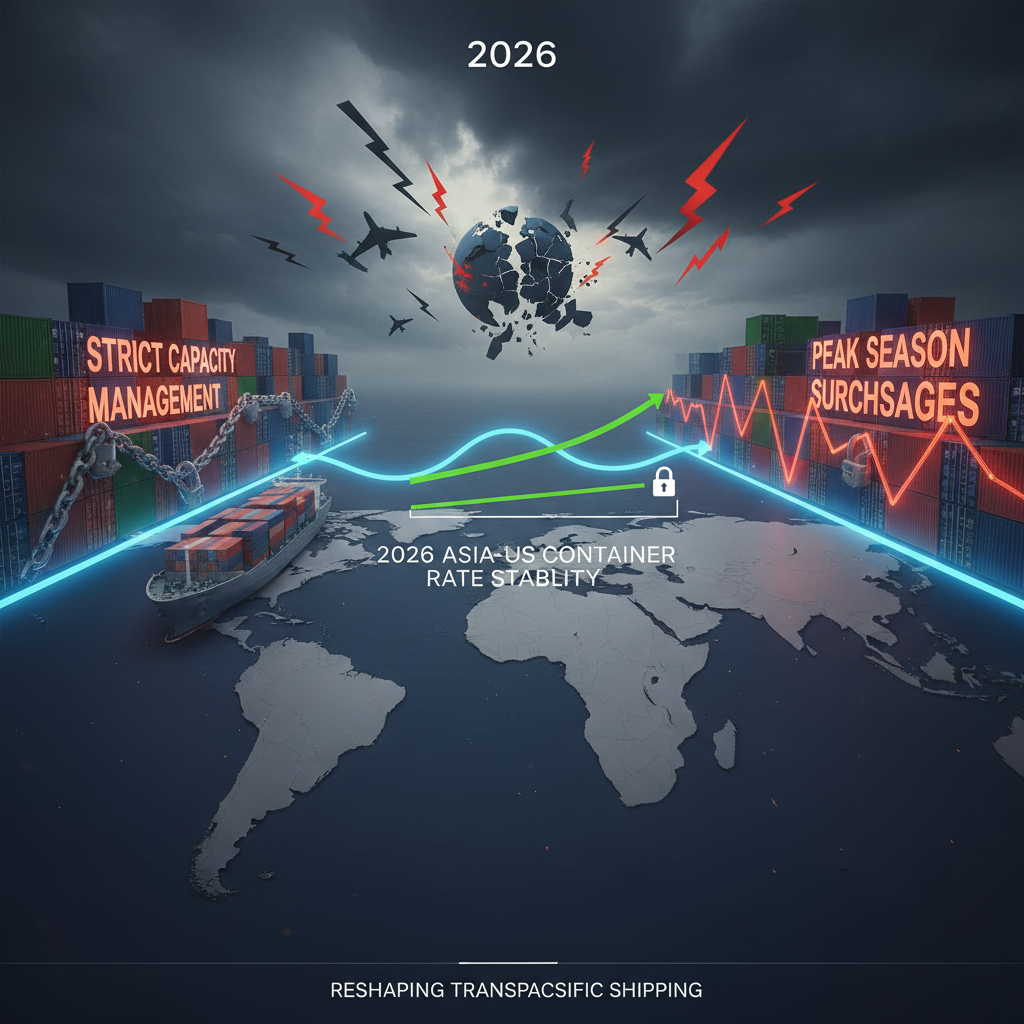
Recent market dynamics have placed Asia-US container rate stability under intense scrutiny as global supply chains navigate a complex matrix of geopolitical disruptions and capacity management strategies. In early 2026, transpacific freight rates demonstrated surprising resilience, bucking the broader east-west market downturn. According to recent data from Drewry’s World Container Index, spot rates from Shanghai to Los Angeles climbed to $2,930 per 40-foot equivalent unit (FEU) by May 2026, representing a significant 34% increase from pre-conflict baselines. This sustained strength indicates a profound shift in how ocean carriers leverage capacity controls to counteract volatile demand signals.
While West Coast routes have maintained firmness, the broader pursuit of Asia-US container rate stability reveals divergent pricing dynamics across different sub-trades. Data from Freightos placed the Far East to US West Coast route at approximately $2,675 per FEU in early May, a 45% jump compared to pre-war pricing. Conversely, rates to the US East Coast have seen marginal fluctuations, with Shanghai to New York routes dropping slightly to $3,483 per FEU. Industry experts attribute this bifurcated reality to persistent supply-demand imbalances and aggressive carrier pricing mechanisms rather than organic volume growth.
To defend baseline revenues, major shipping lines are heavily utilizing peak season and emergency fuel surcharges. For example, Mediterranean Shipping Company (MSC) recently escalated its fuel surcharge on Asia-US East Coast shipments from $430 to $644 per container, while CMA CGM instituted a substantial $2,000 peak season surcharge starting in May 2026. As the industry moves deeper into 2026, long-term Asia-US container rate stability will likely depend on whether disciplined capacity management can effectively counterbalance the overarching threat of vessel oversupply and persistent geopolitical instability.
References
- Global Trade Magazine: Transpacific Rates Rise Against Market Slide (May 2026).
- gCaptain: Container Rates Slip for Third Week as Oversupply Weighs (April 2026).