

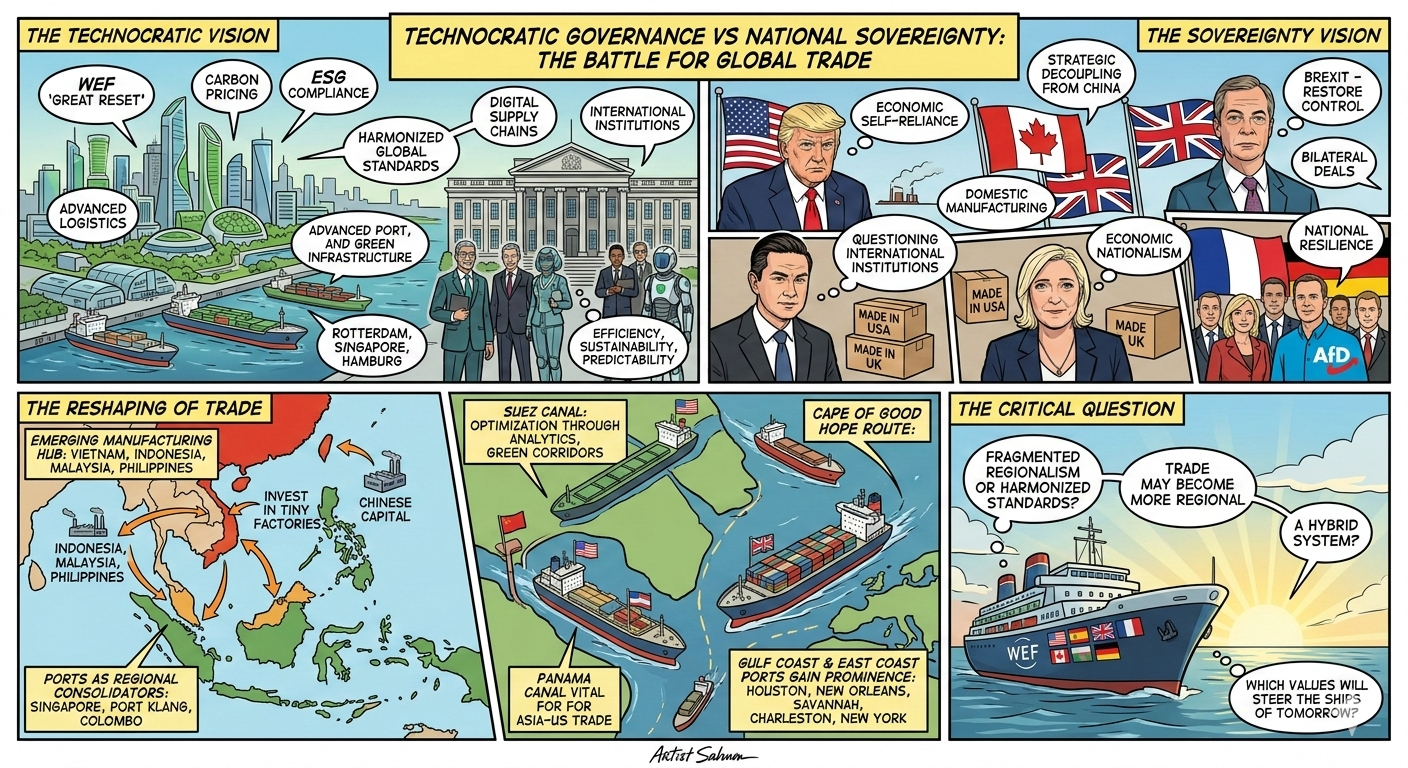
Global trade is entering a period of profound transformation. At stake is not merely the movement of goods, but the ideological architecture that underpins the global economy. On one side stands a vision of technocratic, sustainability-driven global commerce championed by international institutions like the World Economic Forum (WEF).
On the other, various national movements across the political spectrum—including leaders like Donald Trump in the US, Pierre Poilievre in Canada, Nigel Farage in the UK, Marine Le Pen in France, and Germany’s AfD—advocate for national sovereignty, economic self-reliance, and strategic decoupling. The outcome of this contest will reshape trade routes, supply chains, and the geography of prosperity.
The WEF’s “Great Reset” proposes a reimagining of capitalism and global trade. It envisions a world where carbon pricing, ESG compliance, and digital supply chains become the norm. Trade agreements would be governed not just by tariffs and quotas, but by environmental impact, labor ethics, and data transparency.
Ports like Rotterdam, Singapore, and Hamburg—already equipped with advanced logistics and green infrastructure—would thrive under this model. However, questions remain about whether such a system could marginalize developing nations, concentrate power among international institutions, and limit alternative economic models under the framework of global consensus.
In contrast, sovereignty-focused movements are challenging international technocratic frameworks. Trump’s trade policies toward China, Poilievre’s questioning of international institutions, Farage’s Brexit campaign, and Le Pen’s economic nationalism all reflect a desire to restore national control over trade.
This vision favors bilateral deals, domestic manufacturing, and strategic decoupling from China. While it may fragment global trade into regional blocs, proponents argue it offers resilience, local empowerment, and a rebalancing of economic power away from centralized international institutions.
As Western firms seek alternatives to Chinese production, Southeast Asia is emerging as a manufacturing hub. Vietnam, Indonesia, Malaysia, and the Philippines offer competitive labor costs, improving infrastructure, and proximity to key shipping lanes.
Chinese capital, facing political challenges in the West, is increasingly investing in ASEAN. This shift positions ports like Singapore, Port Klang, and Colombo as regional consolidators—feeder hubs that gather cargo from across Southeast Asia for long-haul transshipment to Europe and the Americas. The result is a decentralized, multipolar logistics network reminiscent of Hong Kong and Busan’s rise in the late 20th century.
The reconfiguration of trade flows raises critical questions about maritime logistics. The Suez Canal, long a linchpin of Asia–Europe trade, has faced disruptions—from the Ever Given blockage to geopolitical instability in the Red Sea.
If sovereignty-focused policies prioritize redundancy and security, we may see continued use of the Cape of Good Hope route, echoing the tanker paths of the 1960s and ’70s. Alternatively, technocratic optimization could reinforce Suez’s role through predictive analytics, green shipping corridors, and digital coordination.
Meanwhile, the Panama Canal remains vital for Asia–US East Coast trade. Postpanamax vessels will continue to use this route, while Gulf Coast ports like Houston and New Orleans may gain prominence due to energy exports and manufacturing reshoring. East Coast ports—Savannah, Charleston, New York—stand to benefit from diversified sourcing and reduced reliance on West Coast infrastructure. Shifts in US-China trade policy could accelerate this trend, redirecting cargo through Panama.
The deeper question is whether trade governance will evolve toward harmonized global standards or fragmented regionalism. The technocratic model envisions digital customs, climate-linked tariffs, and ESG enforcement. The sovereignty model favors flexible bilateralism, domestic resilience, and strategic alliances. In practice, we may see a hybrid system: ASEAN rising as a manufacturing hub, the US and EU developing their own standards, and China pivoting toward BRICS and Belt & Road partners. Trade may become less globally integrated and more regional, with overlapping spheres of influence and competing regulatory frameworks.
Global trade is not collapsing—it is reconfiguring. The technocratic vision promises efficiency, sustainability, and predictability, but faces questions about concentration of power. Sovereignty-focused approaches promise national autonomy, resilience, and local empowerment, but face challenges of fragmentation and potential inefficiency.
Ports like Singapore, Colombo, and Port Klang will thrive as regional consolidators, while mega ships ply long-haul routes to Europe and the Americas. Whether they pass through Suez, Panama, or around the Cape will depend not just on geography, but on politics, governance structures, and international trust.
Trade is more than logistics—it is a reflection of values. And the world must now decide which values will steer the ships of tomorrow.