Is Eurasian Transport Corridor Expansion Reshaping Global Logistics?
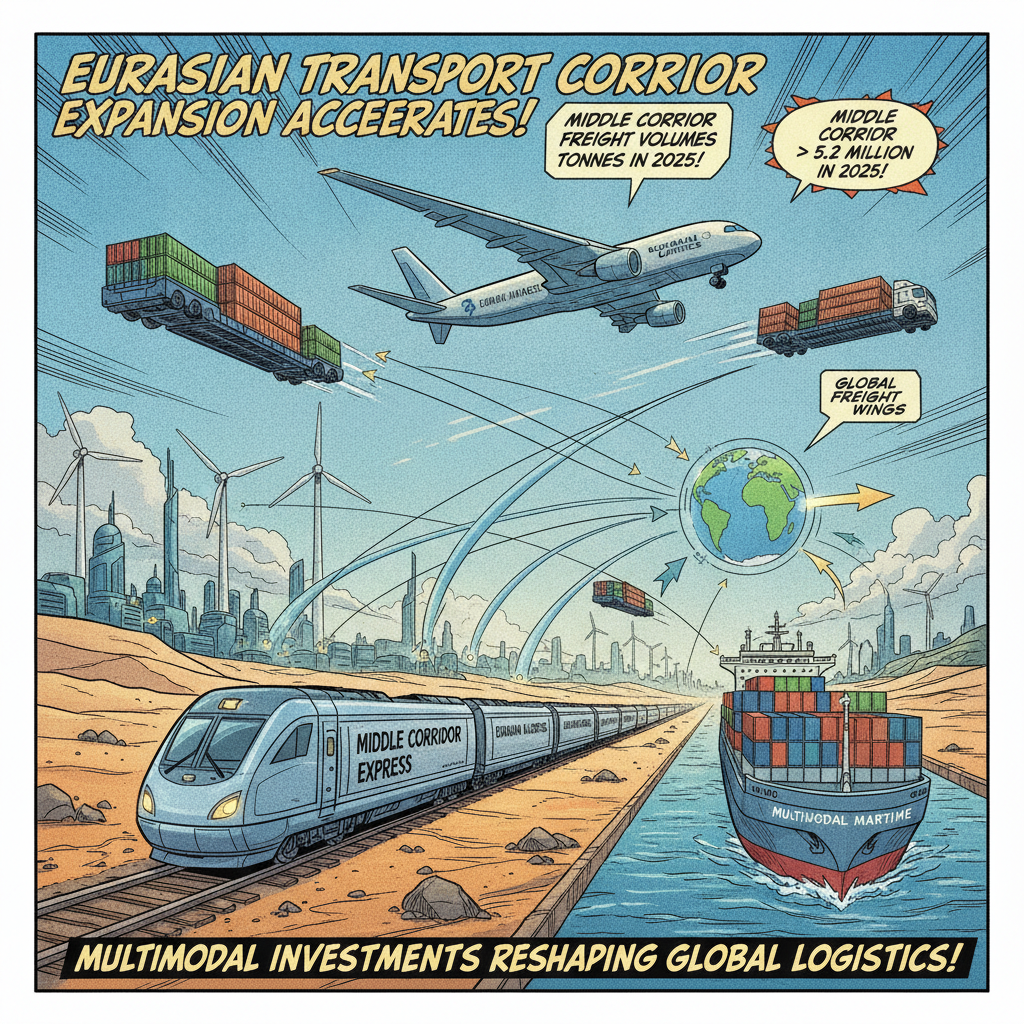
The acceleration of the Eurasian Transport Corridor Expansion is fundamentally altering intercontinental freight architectures. Amid escalating geopolitical tensions in the Red Sea and the Strait of Hormuz, logistics operators are increasingly pivoting toward trans-continental overland and multimodal routes. According to recent data, cargo volumes traversing the Middle Corridor reached approximately 5.2 million tonnes in 2025, marking a staggering increase from earlier years. This surge underscores an urgent industry demand for stable, non-contested geographic chokepoints.
Key Drivers of Eurasian Transport Corridor Expansion
The evolution from a purely conceptual route to a high-capacity freight artery is heavily driven by multinational infrastructure investments. The cost of developing the International North-South Transport Corridor (INSTC) alone was estimated at $44.5 billion in 2025, reflecting a significant capital injection into regional connectivity. Logistics experts are monitoring several critical developments shaping this expansion:
- Multimodal Integration: The core architecture requires seamless transition across rail, port, and maritime networks, particularly across the Caspian Sea.
- Fleet Capacity Scaling: Azerbaijan, Kazakhstan, and Turkmenistan are rapidly directing investments into new vessels to overcome the binding physical bottleneck of limited Caspian shipping capacity.
- Digital Border Solutions: The implementation of unified transit permits and AI-driven border optimization laboratories is actively reducing transit times from 18 days to 15 days.
Navigating Eurasian Transport Corridor Expansion Bottlenecks
Despite robust growth, the Eurasian Transport Corridor Expansion faces significant physical and operational constraints. The discrepancy in railway gauges between China and Central Asia, combined with complex maritime loading procedures, necessitates advanced terminal operations. The Eurasian Development Bank has supported projects worth over $800 million to build logistics hubs to streamline these critical transition points.
Future Trajectory for Forwarders
Industry projections suggest that capacity could scale up to 11 million tonnes by 2030 if current infrastructure funding targets are met. For shipping professionals, maintaining supply chain resilience now requires integrating these Eurasian multimodal corridors into standard origin-to-destination planning.
References
EDB Expands from Central Asia to Abu Dhabi in 2025. CPC: Total freight traffic volume along Middle Corridor increased ninefold compared to 2021. Middle Corridor Rail Freight: When Does the Trans-Caspian Route Make Sense? Middle Corridor Freight Volume Grows Fivefold. Middle Corridor Freight – Euro Cargo Line. Eurasian Transport Network: Projects Observatory and Interactive Map.