
Unprecedented Strain on Global Logistics
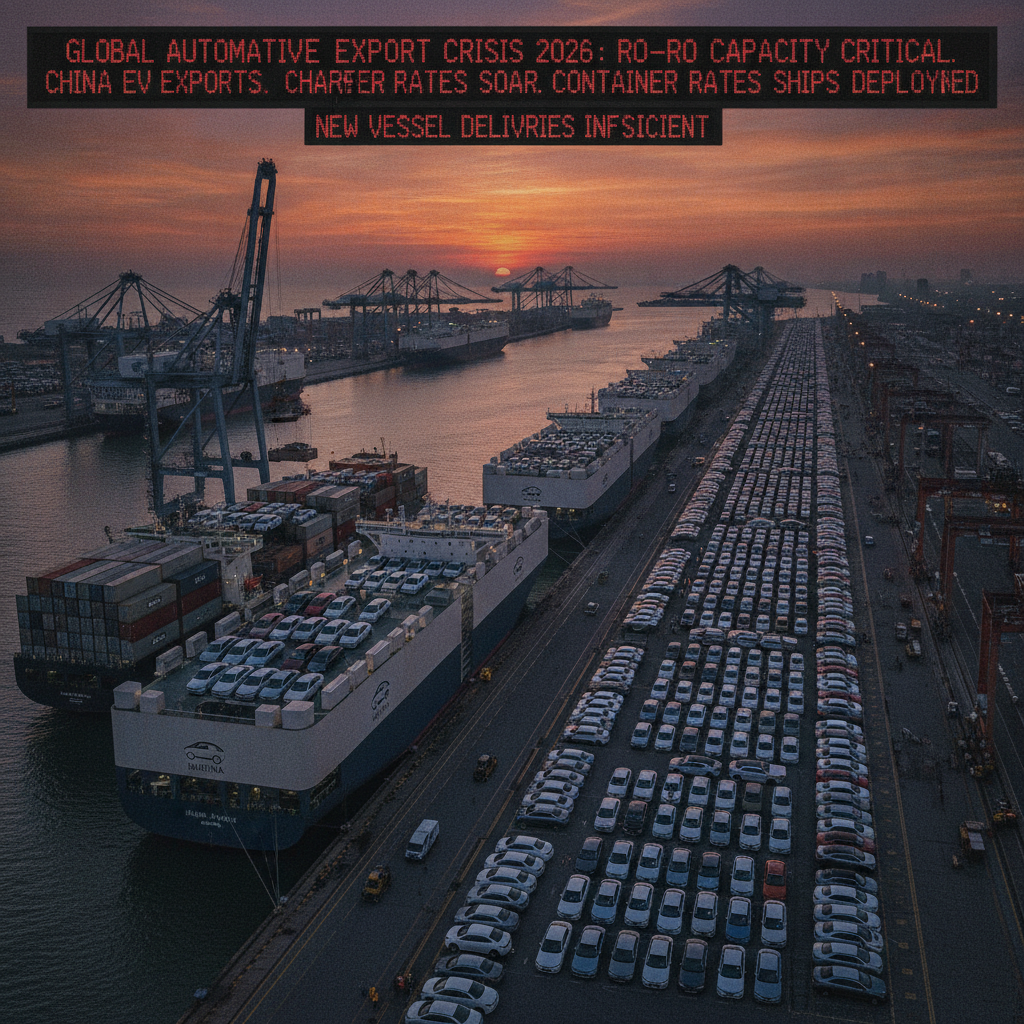
The global shipping industry is facing a severe structural challenge as automotive export Ro-Ro capacity struggles to keep pace with soaring demand. Driven by China’s explosive vehicle export market, which surpassed one million units per month in mid-2026, roll-on/roll-off (Ro-Ro) vessels are operating at maximum utilization. Despite a record 75 new Pure Car and Truck Carriers (PCTCs) delivering in 2025, vessel supply remains constrained. Consequently, time-charter rates have skyrocketed, with large carriers earning up to $100,000 per day.
Factors Constraining Automotive Export Ro-Ro Capacity
Several dynamics are exacerbating the current automotive export Ro-Ro capacity shortage. Automakers are increasingly turning to container ships to transport up to four million vehicles annually.
- Electric Vehicle Weight: Battery-electric vehicles are heavier than combustion cars, maxing out deck weight limits faster than available space.
- Vintage Fleet Extensions: Operators are actively extending the operational life of 30-year-old vintage ships to alleviate the capacity crunch.
- Newbuilding Timelines: Energy-efficient newbuildings can take up to three years to deliver despite a recovering 20.4% orderbook-to-fleet ratio.
The 2026 Outlook for Automotive Export Ro-Ro Capacity
Chinese automakers are pivoting aggressively toward international expansion, cementing the need for specialized ocean freight. Consequently, some manufacturers are transitioning into vessel owners to secure long-term capacity. Industry analysts suggest that until larger, 10,000+ CEU vessels integrate by 2028, the squeeze on automotive export Ro-Ro capacity will persist. Logistics professionals must prioritize multi-modal transport strategies to navigate this bottleneck.