
Is Global Warehousing Capacity Utilization Maxed Out in 2026?
In the highly volatile logistics sector, tracking Global Warehousing Capacity Utilization is critical for maintaining supply chain efficiency and profitability. As of early 2025 and moving deeper into 2026, the industrial real estate market is balancing massive post-pandemic overbuilding with shifting e-commerce demands. Operators are now facing a complex landscape where high utilization and rising rents coexist.
Benchmarks for Global Warehousing Capacity Utilization
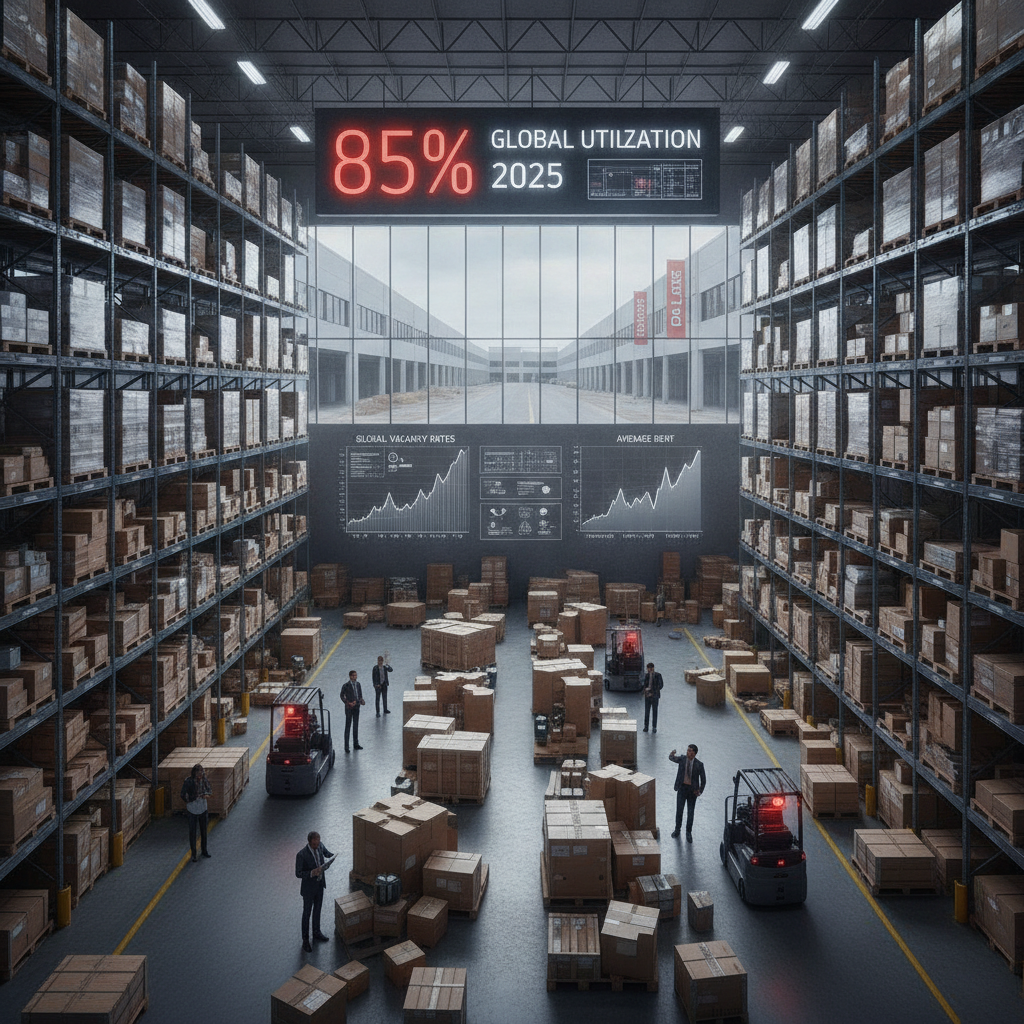
Industry experts agree that an 80% to 85% capacity utilization rate represents the optimal threshold for modern warehouses, allowing sufficient buffer for seasonal inventory fluctuations. However, the Prologis Industrial Business Indicator revealed that average utilization climbed to 85.3% in January 2025. Pushing Global Warehousing Capacity Utilization beyond this limit typically generates operational bottlenecks, elongates picking paths, and exponentially increases labor and handling costs.
Vacancy Rates vs. Global Warehousing Capacity Utilization
Paradoxically, while active facilities are highly utilized, overall market vacancy has surged. In the United States, warehouse vacancy reached an 11-year high of 7.1% by mid-2025, driven by a record 322 million square feet of newly delivered supply. Internationally, markets like China’s Greater Bay Area recorded high-standard warehouse vacancy rates of 15.2% due to a pullback in cross-border e-commerce. Despite this available space, industrial rents have continued to climb, forcing logistics experts to maximize their existing footprints.
Optimizing Global Warehousing Capacity Utilization
To navigate these challenging market conditions, operators must modernize their space management strategies:
- Leverage Predictive Analytics: Use customer data enrichment to align inventory levels with actual purchasing behaviors rather than outdated forecasts.
- Enhance Vertical Space: Implement dynamic slotting and lean inventory practices to maximize cubic volume without expanding the physical footprint.
- Invest in Automation: Integrate automated storage and retrieval systems (ASRS) to offset rising labor costs and accelerate throughput in densely packed environments.