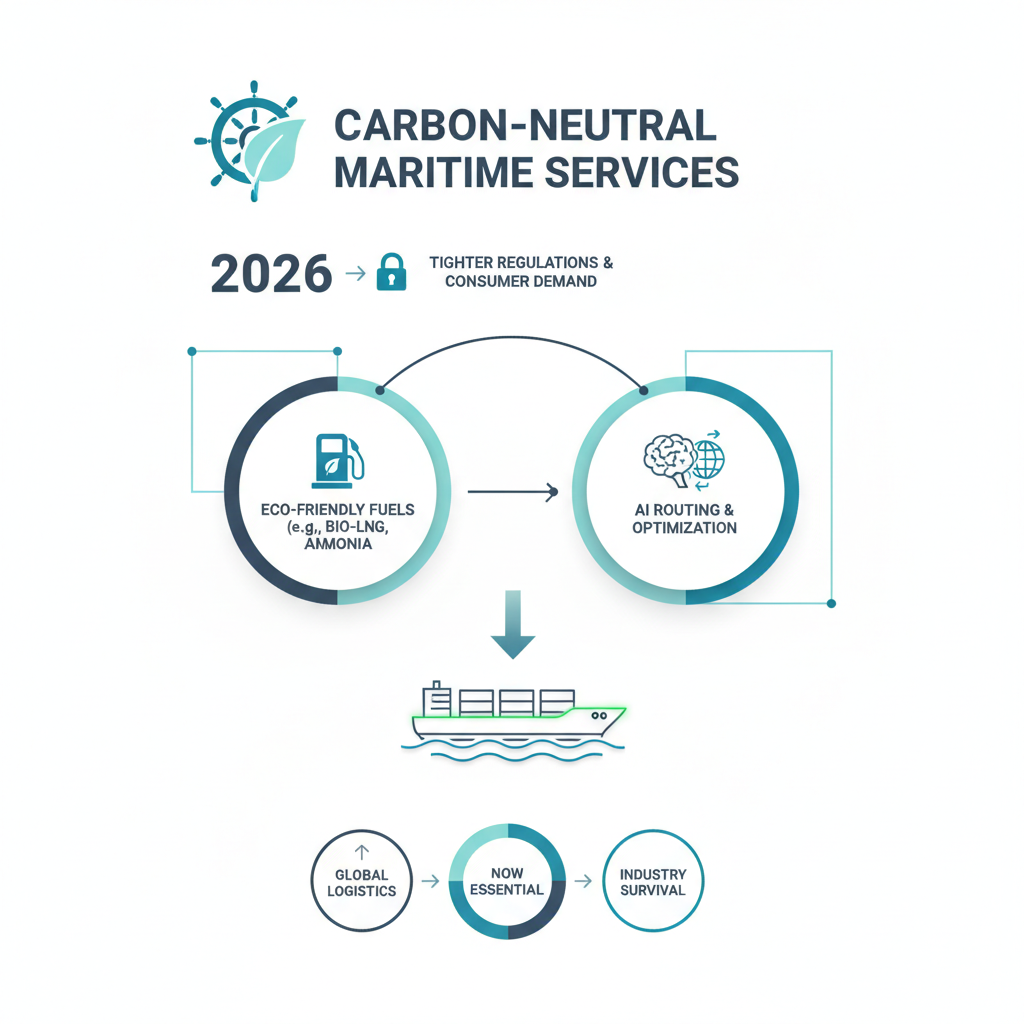
The maritime industry, responsible for approximately 3% of global greenhouse gas emissions [1], is undergoing a radical transformation. In 2026, integrating Carbon-Neutral Maritime Services has evolved from a corporate social responsibility initiative into a strict operational necessity. A 2025 industry analysis indicated that 78% of consumers now expect carbon-neutral delivery options, directly pressuring global supply chains [2]. Furthermore, the 2026 Sea Cargo Charter Annual Disclosure Report revealed that 20 out of 29 major signatories successfully reduced their carbon emission intensity in the previous year [3].
Logistics and shipping experts are rapidly deploying new strategies to align with stringent global environmental standards. The pending adoption of the International Maritime Organization (IMO) Net-Zero Framework in late 2026 has significantly accelerated these strategic shifts [4].
- Biofuel Integration: Biofuels currently stand as the most mature alternative fuel pathway across major shipping groups in 2026 [3].
- EU ETS Compliance: Under the European Union Emissions Trading System, shipping companies must surrender allowances for 70% of their reported emissions in 2026, scaling to 100% by 2027 [5].
- AI Route Optimization: Artificial intelligence is actively deployed to optimize shipping routes in real-time, yielding a 15-25% reduction in CO2 emissions [2].
For logistics professionals, transitioning to Carbon-Neutral Maritime Services is essential for long-term viability. As sustainable methanol costs hover around $49 per Gigajoule compared to $19 for conventional sulfur fuel oil, experts must balance green innovation with commercial efficiency [3]. Navigating these costs requires precise AI-driven supply chain forecasting and strategic fleet investments.
References
[1] Global Maritime Forum (globalmaritimeforum.org) [2] FreightAmigo: Consumer demand for carbon-neutral deliveries (freightamigo.com) [3] S&P Global: Major ship operators show small progress on emissions targets (spglobal.com) [4] RNG Strategy Consulting: Strategic Roadmap for Maritime Decarbonization in 2026 (rngstrategy.com) [5] EU Climate Action: Reducing emissions from the shipping sector (climate.ec.europa.eu)