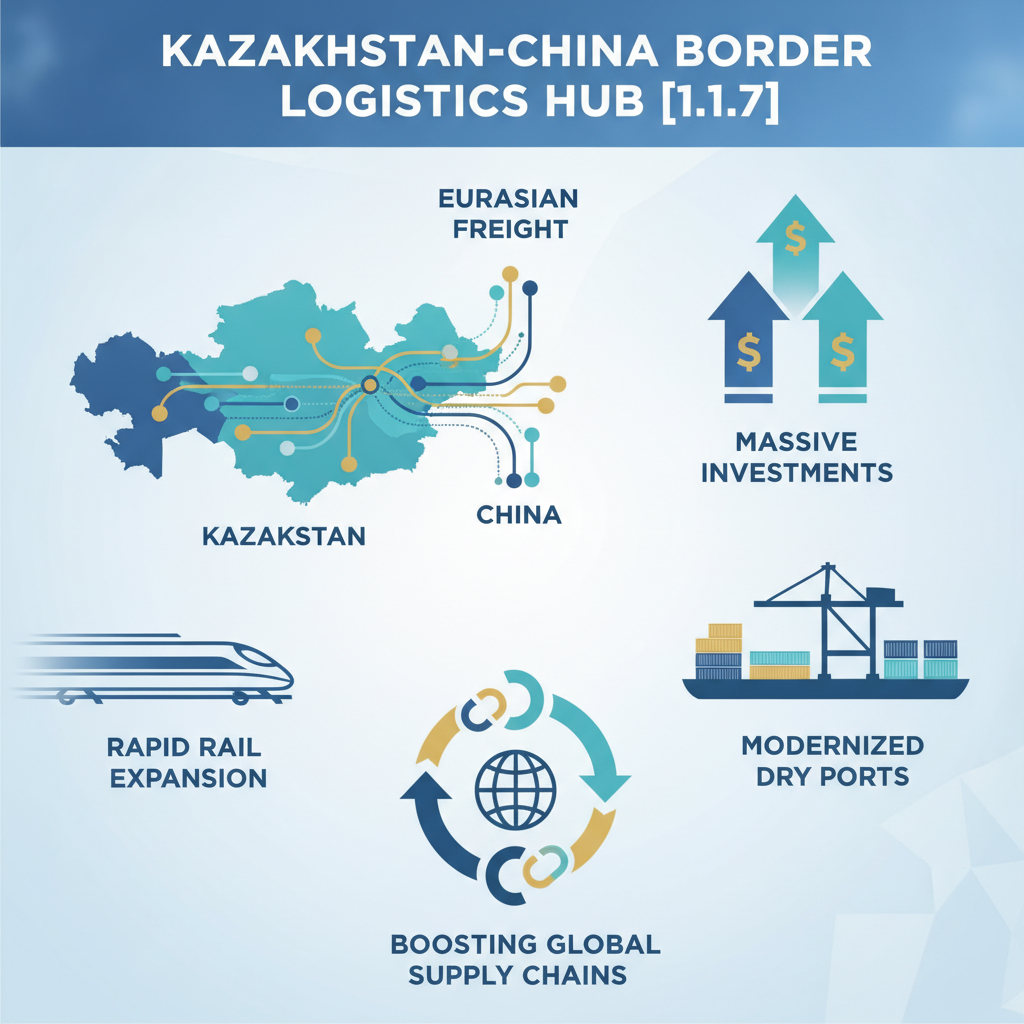
As global supply chains shift, the Kazakhstan-China Border Logistics Hub [1.1.7] has emerged as a critical growth catalyst for transcontinental trade. This strategic corridor has undergone massive infrastructural upgrades to accommodate booming freight volumes between Asia and Europe. In 2025, container processing at key border zones like the Khorgos Gateway reached 372,000 TEUs, marking a steady 2% year-over-year increase despite macroeconomic headwinds. This growth trajectory underscores the necessity of modernizing transshipment facilities.
International stakeholders are actively accelerating infrastructure investments to scale the region’s operational capacity. In mid-2026, the Belgian heavy-lift firm Sarens announced a $56 million investment to develop an 82-hectare commercial and logistics hub near Khorgos to ease truck congestion. The first phase of this ambitious project is projected to be operational by late 2026, with full completion expected in 2027. Furthermore, plans for a new border crossing parallel to the Nur Zholy checkpoint are currently in development to further unblock the Kazakhstan-China Border Logistics Hub [1.1.7].
Recent technological and structural advancements have drastically reduced freight delays along the Silk Road. The introduction of ten new broad-gauge railway lines and intelligent handling systems slashed container transfer times from five hours to just one hour. Additionally, the construction of the massive Kolzhat Dry Port, which expects cargo traffic to triple to 1.4 million tons by 2030, provides a vital supplementary artery for regional commerce. Industry experts agree that these phased developments will solidify the region’s position as the premier transit corridor connecting China to Western markets.
References
- The Astana Times (https://astanatimes.com/)
- Khorgos Dry Port Accelerates Eurasian Transit
- LS.com / The Astana Times on Kolzhat Dry Port