
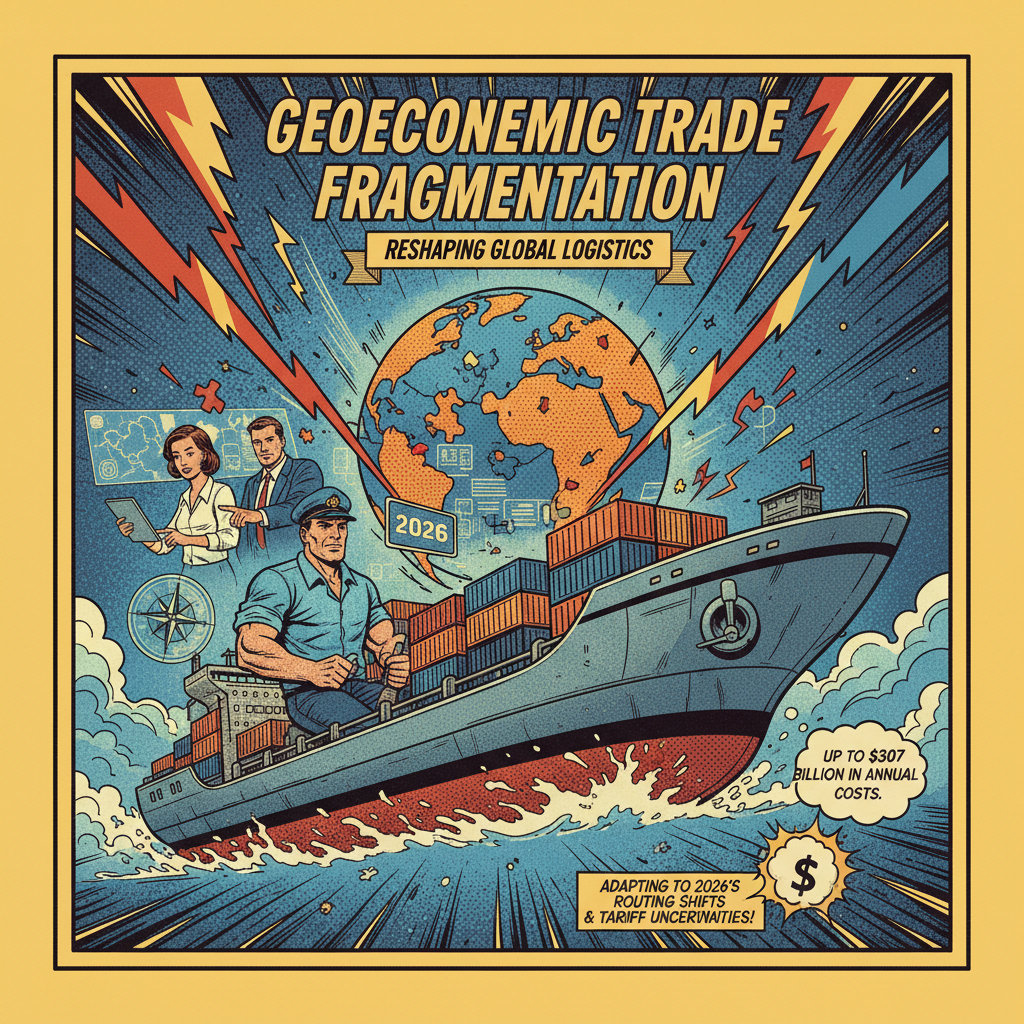
For global logistics and shipping experts, the landscape of international commerce has fundamentally shifted. Geoeconomic Trade Fragmentation is no longer merely a theoretical risk, but a daily operational reality driving supply chain re-engineering. According to a 2026 World Economic Forum report, this fragmentation is imposing an annual cost of $213 billion to $307 billion on the global economy.
Rather than a complete retreat from globalization, the industry is witnessing selective decoupling and strategic rerouting. The global trading system surprisingly reached a record $35 trillion in value in 2025, but the underlying routes have drastically transformed.
Recent geopolitical shocks have made resilience the primary organizing principle for modern supply chains. The closure of the Strait of Hormuz in March 2026, which impacted 20% of the global seaborne oil supply, highlighted the extreme vulnerability of traditional maritime chokepoints. Furthermore, expanding tariffs and reciprocal trade measures have forced companies to rethink inventory and sourcing.
- Supplier Diversification: A Q1 2026 TradeBeyond report reveals that 43% of supply chains made significant sourcing geography changes in 2025 to mitigate tariff impacts.
- Rise of Friendshoring: The IMF noted a distinct decrease in trade between historically misaligned geopolitical blocs, with trade flows becoming highly sensitive to political distance.
- Digital Infrastructure: To combat uncertainty, 74% of logistics respondents plan to increase investments in supply chain digitization in 2026.
Shipping leaders are abandoning lean, single-source models in favor of regionalized, multi-hub strategies. Managing Geoeconomic Trade Fragmentation requires a proactive approach to risk, balancing cost efficiency with structural security. As noted by Gallagher’s 2026 research, geopolitics has officially become a core strategic variable that dictates long-term value in the shipping sector.
References
- World Economic Forum (2026). Trade and Financial Fragmentation spreads beyond Rivals as Costs mount.
- Gallagher Supply Chain Risk Research (2026). How Organizations Are Reshaping Their Supply Chains.
- European Parliament (2026). EU supply chains in the era of trade fragmentation.
- TradeBeyond / Inbound Logistics (2026). Global Supply Chain Trends.
- UNCTAD / World Economic Forum (2026). Tariff shock, protectionism and the rise of the Global South.