
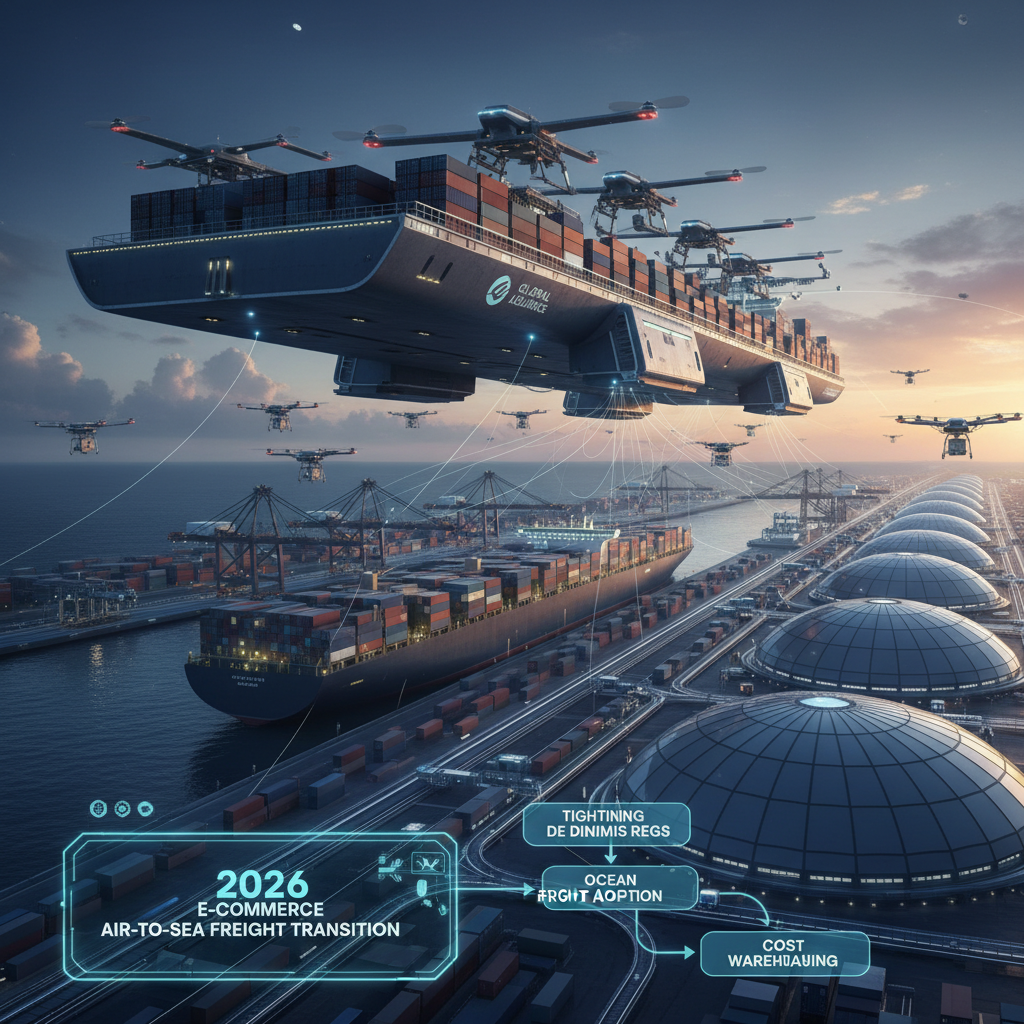
The global logistics landscape is undergoing a systemic transformation. Driven by tightening “de minimis” regulations, platforms are accelerating the E-Commerce Air-to-Sea Freight Transition. Historically reliant on air freight, e-commerce giants are restructuring supply chains to maintain profitability.
Trade policy shifts have impacted the viability of parcel-by-parcel air shipments. In the US and Europe, removing tax-free thresholds has raised costs for direct air imports. Similarly, Turkey abolished streamlined customs systems in early 2026, forcing e-commerce models to pivot toward traditional B2B ocean freight.
To combat margin pressures, leaders are building overseas warehouses and moving replenishment to ocean freight. Key developments include:
- Cost Optimization: Using fast vessel sea routes for restocking has reduced logistics costs to under $10 per kilogram.
- Warehousing Shifts: Forward warehouses are projected to handle up to 25% of total US volume for major platforms by 2026.
- Multimodal Resilience: SMEs are leveraging Less-than-Container Load (LCL) shipments to stabilize expenditures.
While air delivery remains crucial for priority stock, the E-Commerce Air-to-Sea Freight Transition establishes a new industry baseline. Logistics providers must adapt by offering regional hub optimization and robust customs clearance solutions to thrive.
References
Shenzhen Topway Forwarding. “Temu, Shein Are Out” (2026). Tech Buzz China. “Temu Watch 10” (2025). Tech Buzz China. “Temu Watch 10” (2025). “How E-Commerce is Reshaping Freight” (2026). “E-commerce Shift from Air to Ocean” (2025). Tradlinx. “Air vs. Ocean Freight” (2025).