
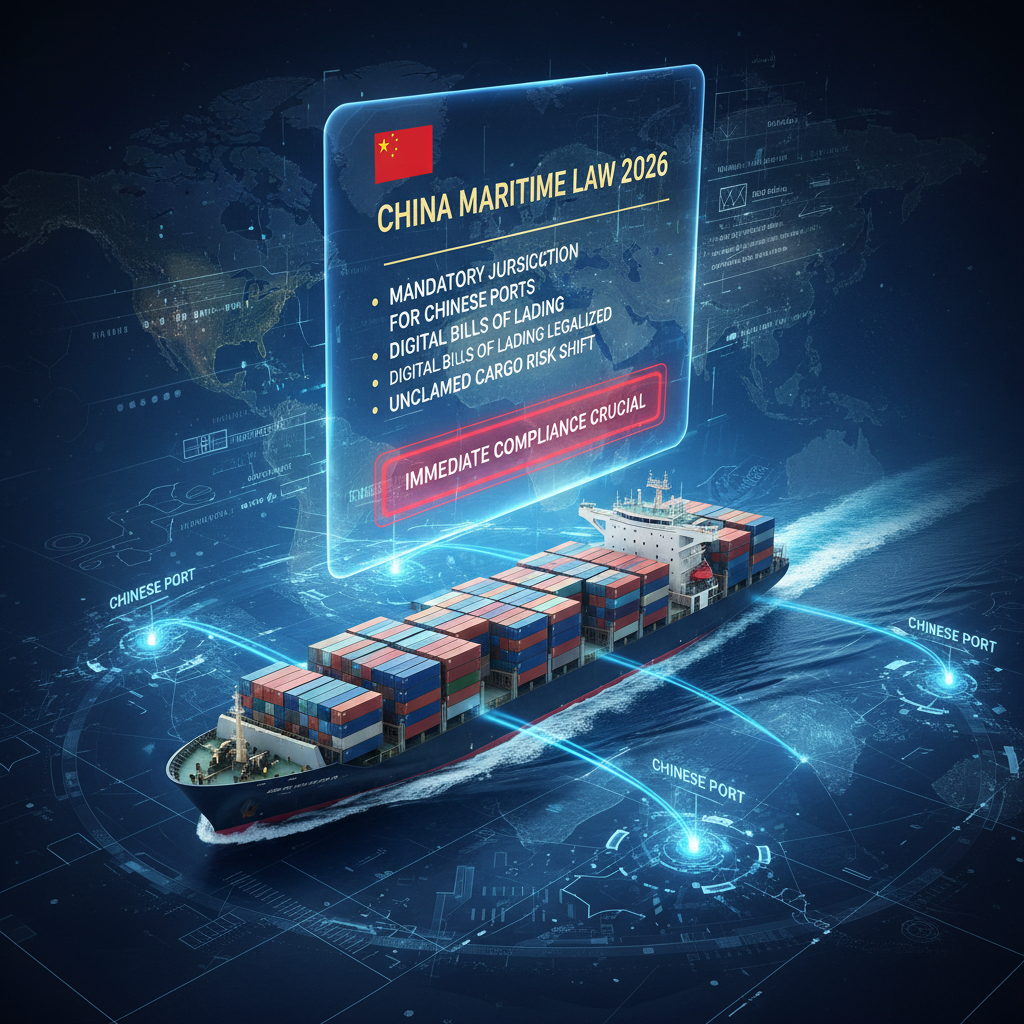
The highly anticipated China Maritime Law 2026 officially came into force on May 1, 2026, marking the most extensive overhaul of the nation’s maritime legislation since 1993. For logistics professionals and shipping experts worldwide, these revisions dictate immediate strategic adjustments. By addressing digital transformation, environmental liability, and jurisdictional authority, the China Maritime Law 2026 fundamentally recalibrates risk allocation across the global ocean freight supply chain.
Perhaps the most disruptive element of the China Maritime Law 2026 is the introduction of Article 295. This specific provision mandates that Chinese maritime law applies compulsorily to any international contract of carriage where either the port of loading or the port of discharge is within Chinese territory. Consequently, traditional choice-of-law clauses favoring English or other foreign legal frameworks can now be overridden, significantly altering international dispute resolution for carriers.
The updated legislation introduces practical logistics controls that require immediate global compliance. Logistics operators must adapt their standard operating procedures to account for the following statutory changes:
- Expanded Carrier Definitions: Under Article 44, the definition of an actual carrier now covers subcontractors and terminal operators who handle goods, expanding both their liability and legal protections.
- Unclaimed Cargo Allocation: The risks and costs associated with uncollected cargo at discharge ports are now shifted directly to the contractual shipper.
- Electronic Bills of Lading: To support digital trade, the revised law grants formal legal status to electronic transport records, matching UNCITRAL standards.
- Environmental Accountability: A newly added chapter imposes strict financial guarantees and insurance requirements for ship oil pollution liability.
Adapting to the China Maritime Law 2026 requires more than a cosmetic update to shipping contracts. Stakeholders must proactively audit their bills of lading, update cargo handling timelines, and ensure readiness for digital documentation. Reactive compliance is no longer a viable strategy for vessels touching Chinese ports.
References
Logistics Great. “How Will China Maritime Law 2026 Compliance Shape Global Shipping?”
“China’s Maritime Code 2026 – sea of change”
Steamship Mutual. “The Revised Chinese Maritime Code – FAQs”
National People’s Congress. “China passes its newly revised Maritime Law”
Global Law Experts. “China Maritime Code 2026 Changes”