
In a telling reflection of current maritime economics, A.P. Moller-Maersk reported a significant downturn in its core shipping operations for the first quarter of 2026. Despite robust global demand, the widely discussed Maersk Q1 2026 container division EBIT loss underscores the mounting pressures of industry overcapacity and volatile freight rates.
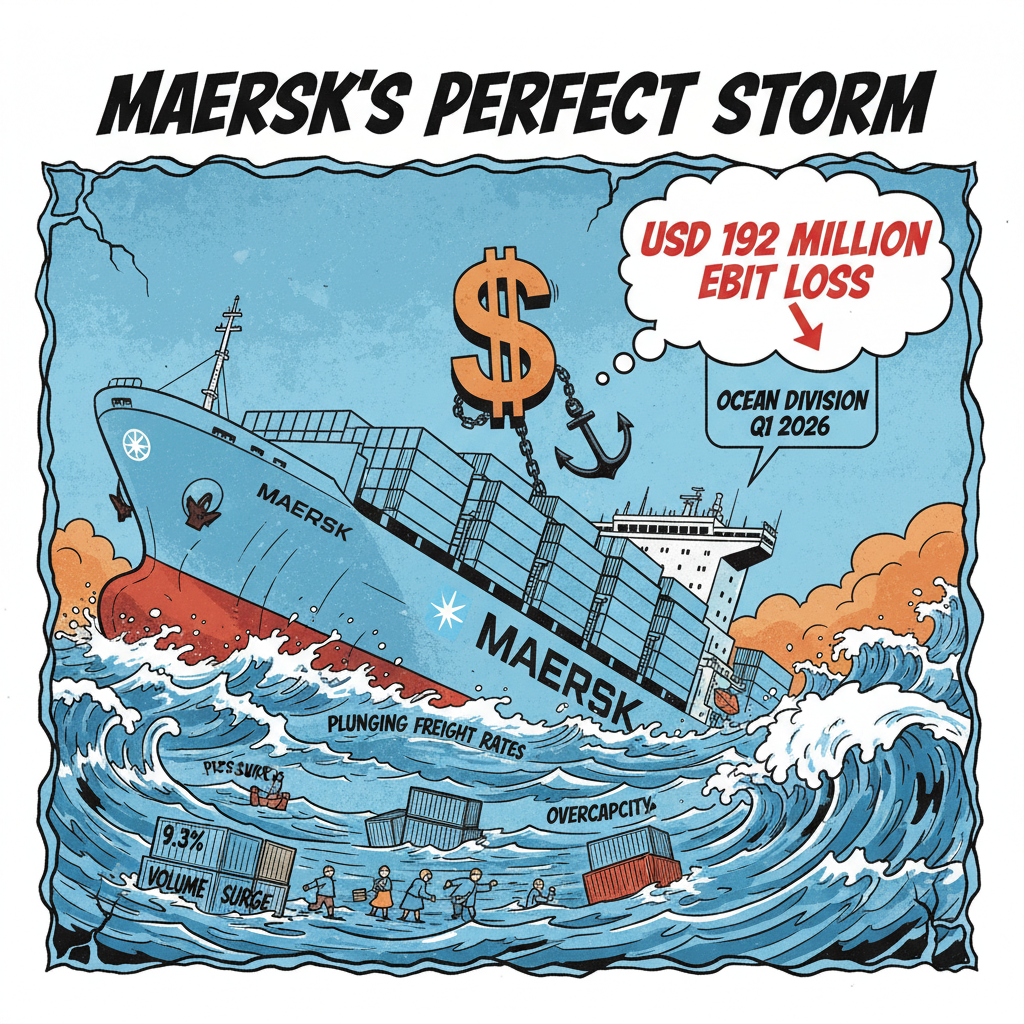
The global shipping giant revealed that its Ocean segment swung to an EBIT loss of USD 192 million in Q1 2026, a stark contrast to the USD 743 million profit recorded during the same period in 2025. While the broader company achieved a positive overall EBIT of USD 340 million—bolstered by strong performances in its Terminals and Logistics units—the container division struggled against structural market headwinds.
Several critical factors contributed to this financial shift:
- Plunging Freight Rates: Average loaded freight rates plummeted by 14% year-over-year to USD 2,081 per FFE, severely impacting Ocean revenue.
- Volume Growth vs. Oversupply: Despite a 9.3% surge in loaded volumes driven by strong Chinese exports, an influx of new vessel deliveries created persistent capacity oversupply.
- Geopolitical Disruptions: Conflicts in the Middle East introduced operational complexities, though Maersk mitigated some impacts by reducing unit costs by 7.1%.
CEO Vincent Clerc emphasized that disciplined cost management and flexible network design remain competitive differentiators. Moving forward, Maersk maintains its full-year 2026 guidance, projecting global container market volume growth between 2% and 4%. Sustained recovery will heavily depend on balancing global vessel capacity against shifting trade momentum.
References
Seatrade Maritime News (seatrade-maritime.com) | DatamarNews (datamarnews.com) | Trans.INFO (trans.info) | Container News (container-news.com)