
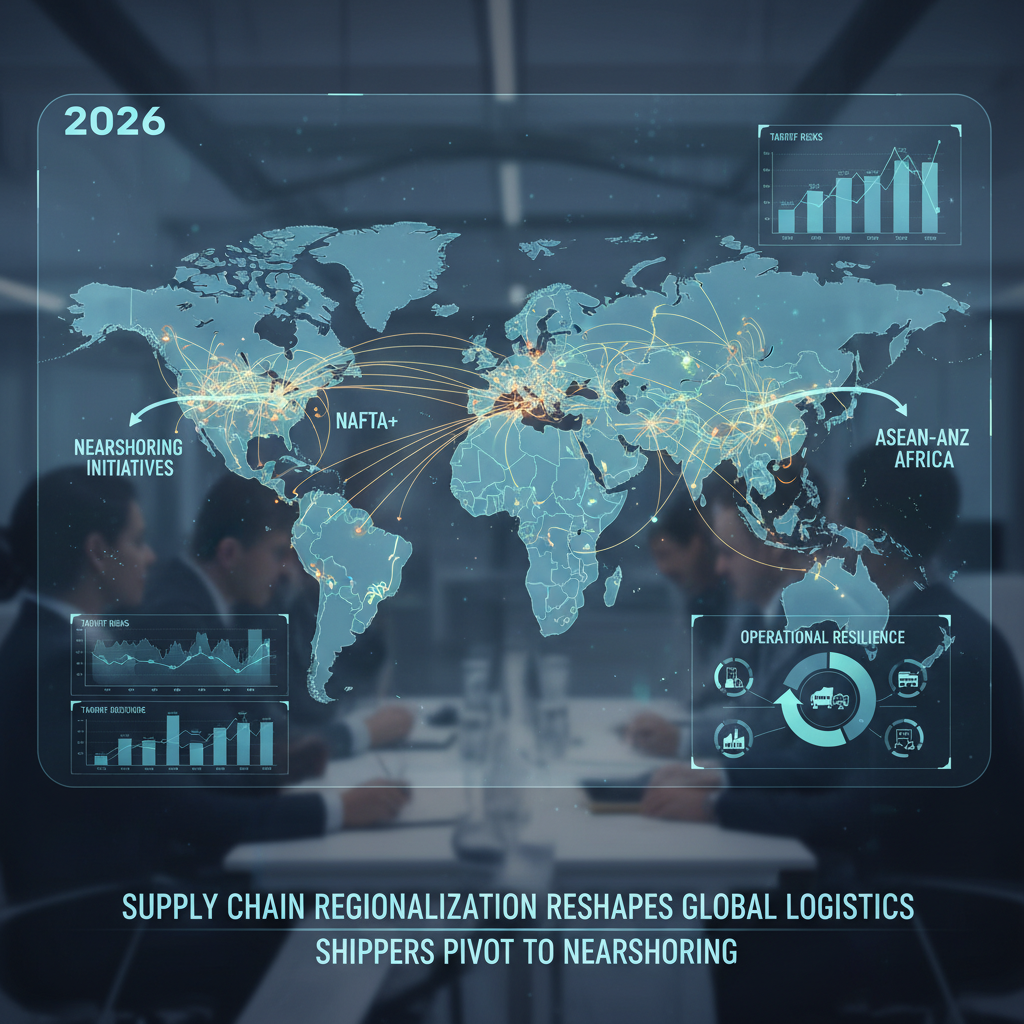
The era of hyper-globalized logistics is rapidly ending as Supply chain regionalization becomes the dominant strategy for 2026. Facing volatile tariff policies and geopolitical fragmentation, companies are moving production closer to end consumers. This structural shift from purely cost-driven models to localized resilience is profoundly altering global maritime trade and freight networks.
Recent data indicates that the transition toward localized hubs is accelerating faster than anticipated. A recent Gartner forecast projects that 60% of global trade routes will undergo significant reconfiguration by 2027. Furthermore, nearly 60% of logistics executives anticipate their networks will become highly regionalized over the next few years. By pivoting away from single-source dependencies, multinational corporations are actively duplicating their logistics footprints to build self-sufficient regional blocs.
Logistics professionals must adapt to several emerging nearshoring dynamics:
- Trade Route Reconfiguration: There is a surging demand for intra-regional transport and recalibrated feeder networks connecting smaller regional ports.
- Inventory Redesign: Shippers are building redundant inventories across Mexico, Southeast Asia, and Eastern Europe to bypass border delays.
- AI-Driven Analytics: Companies leveraging predictive analytics are maintaining 20% higher asset utilization during volatile trade shifts.
Transitioning from a centralized model to a comprehensive regional hub approach is no longer optional. While structural costs may temporarily increase due to duplicate facilities, localized supply networks dramatically reduce exposure to external shocks. For the modern logistics leader, mastering this decentralized environment is critical to maintaining operational continuity and securing a competitive advantage.
References
https://www.marinelink.com/news/supply-chain-regionalization
https://iscn.academy/from-2025-to-2026
https://www.traxtech.com/los-angeles-port-volumes
https://medium.com/the-global-supply-chain-just-broke
https://www.prologis.com/research/supply-chain-3-0
https://www.hisoair.com/build-a-regional-supply-chain
https://www.scribd.com/document/us-discount-retail-2025