
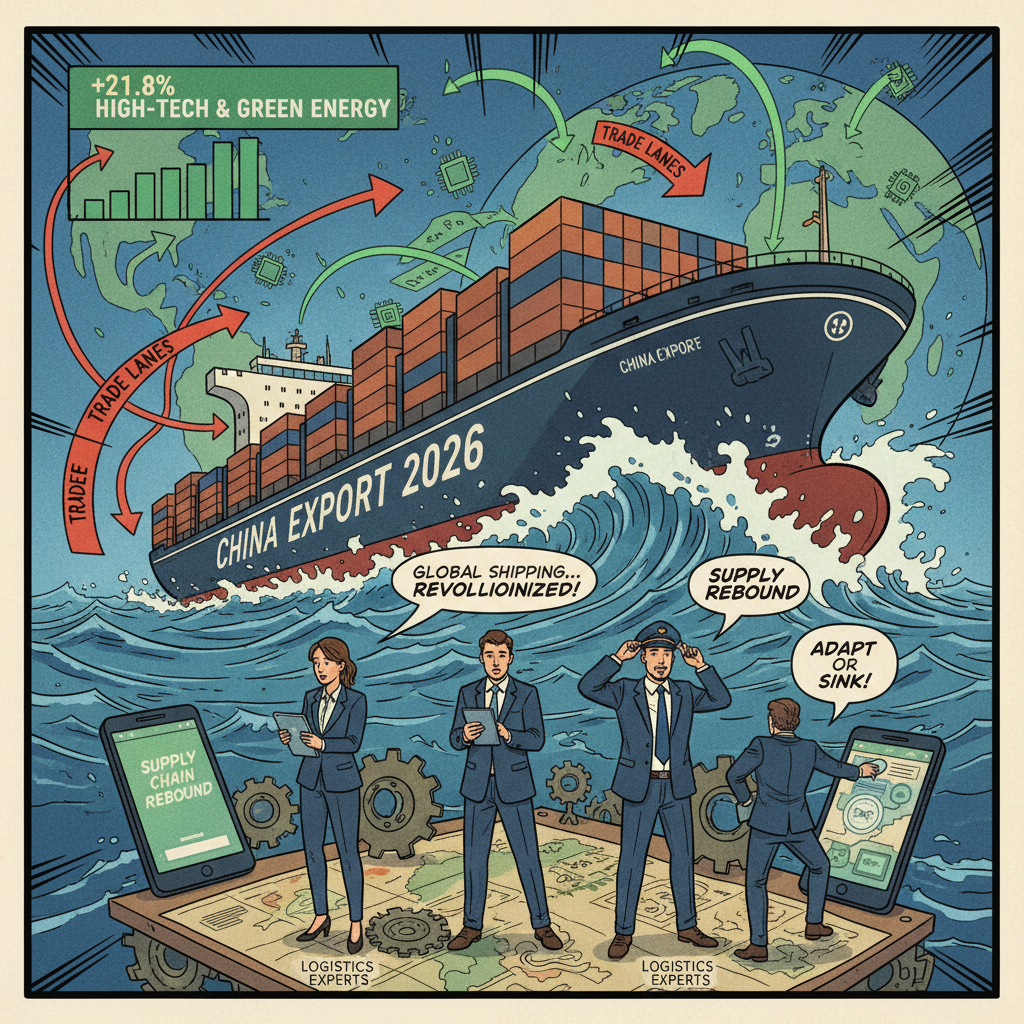
The global logistics sector is currently witnessing a massive shift as the China export supply chain rebound gathers unprecedented momentum in early 2026. Following a transformative 2025, where China’s total import-export volume hit a record $6.36 trillion and its trade surplus breached $1.19 trillion for the first time, the trajectory has only steepened. Recent data reveals that Chinese exports grew by a staggering 21.8% year-on-year in the first two months of 2026, marking the highest monthly growth level since early 2022. For shipping and logistics professionals, this sharp recovery dictates an urgent reassessment of vessel capacities, freight routing, and global supply chain resilience.
Unlike previous cycles relying on low-cost goods, the current China export supply chain rebound is overwhelmingly fueled by high-value, technology-intensive manufacturing. This structural upgrade has a direct impact on specialized freight forwarding and capacity planning.
- Surging High-Tech Demands: Early 2026 saw semiconductor exports spike by 72.6%, alongside automotive exports increasing by 67.1%.
- Geopolitical Market Shifts: While U.S.-bound volumes experienced declines due to ongoing tariff implementations, alternative trade lanes absorbed the capacity. Exports to the ASEAN region and the EU surged by 29.4% and 27.8% respectively.
- Green Energy Boom: The new green sectors—electric vehicles, lithium batteries, and solar products—continue to dominate specialized ocean and rail freight volumes.
To capitalize on the China export supply chain rebound, forwarders must adapt to new geopolitical and regulatory realities. Carriers are actively embracing China-plus-one routing strategies, complementing Chinese origins with secondary hubs in Vietnam and Mexico to mitigate bottleneck risks. Furthermore, professionals must navigate the new Chinese export compliance regulations implemented in October 2025, which ended third-party declarations and tightened tax registrations for exporters. As container volumes continue their upward trajectory, securing advance bookings, hedging against volatile spot rates, and diversifying trade lanes will be critical for maintaining uninterrupted global operations.
References
China Briefing: China’s Import-Export in 2025. ING Think: China’s trade growth starts 2026 strong. D&D Worldwide Logistics: New Chinese Export Compliance Regulations. BaySource Global: Sourcing After Supply-Chain Disruption.