As the logistics industry enters its busiest quarter, major carriers have implemented aggressive pricing strategies. Navigating Global peak season parcel surcharges has become a critical focus for small and large shippers alike, with the National Retail Federation forecasting $1.013 trillion in 2026 holiday sales.
Analyzing the 2026 Global Peak Season Parcel Surcharges
In response to elevated volume and network capacity constraints, carriers like UPS, FedEx, and USPS have rolled out tiered peak demand fees. For a standard light parcel, these surcharges add roughly $0.40 to $0.80, heavily impacting retailers offering free shipping. These financial adjustments typically span from late September 2026 through mid-January 2027.
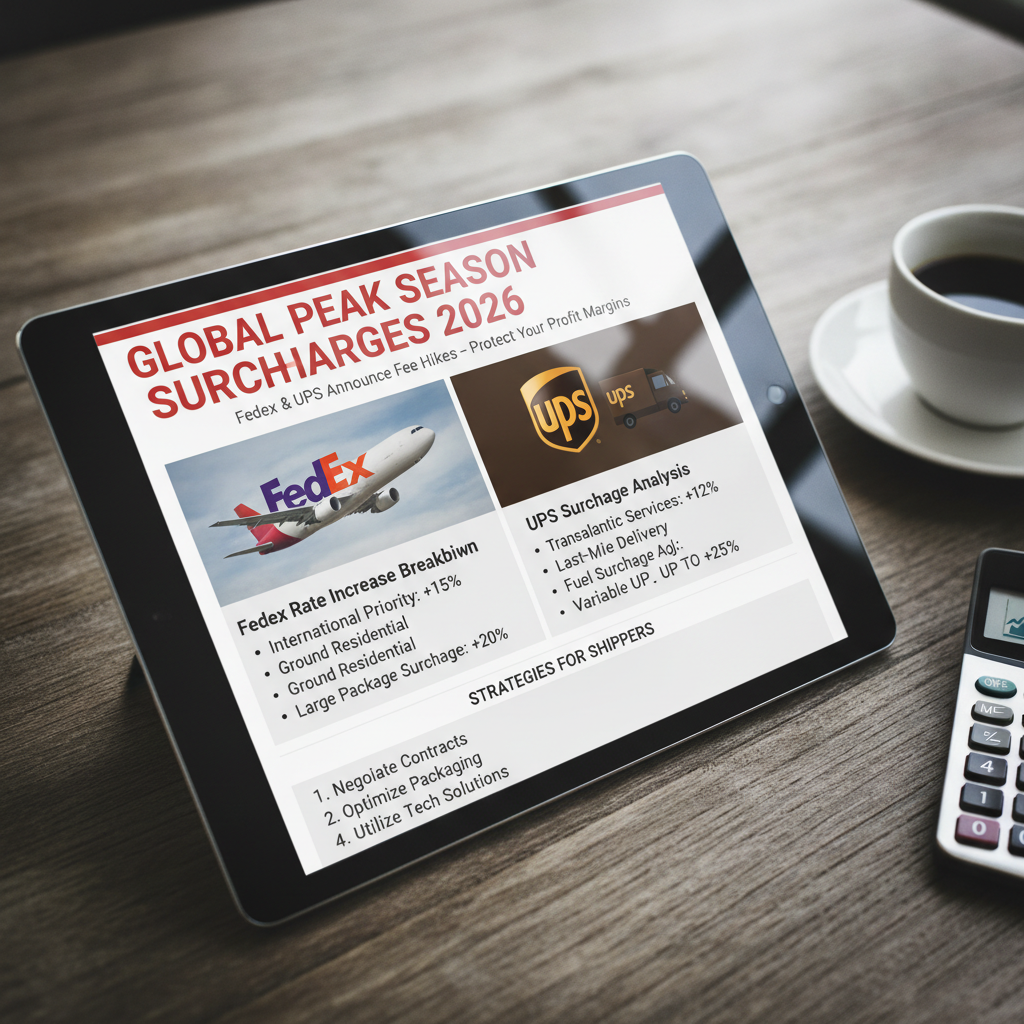
FedEx and UPS Global Peak Season Parcel Surcharges Data
Both UPS and FedEx have aligned their steepest hikes during the core holiday weeks. Between late November and December 2026, FedEx is applying an $11.85 fee for additional handling and up to $117.25 for oversize packages. UPS mirrors this pricing trajectory, increasing additional handling fees to $11.90 and charging up to $590 for packages exceeding maximum limits. Furthermore, residential delivery demand fees sit around $0.80 for FedEx and $0.75 for UPS per package during the rush.
Strategies to Offset Global Peak Season Parcel Surcharges
Understanding these rigid pricing shifts is vital to preserving profit margins. Shippers are encouraged to leverage regional carriers and refine package dimensions to avoid large-package penalties. Shifting to store-fulfillment models can also mitigate these substantial logistical cost increases.
References
FedEx Demand Surcharges: https://www.fedex.com/
UPS August 2026 Demand Surcharges: https://www.ups.com/
Forbes – Why Small Retailers Are Rethinking Free Shipping: https://www.forbes.com/