Can Logistics Leaders De-Risk the Critical Minerals Supply Chain?
For global logistics and shipping experts, the theoretical vulnerabilities of the critical minerals supply chain have morphed into tangible operational disruptions. The International Energy Agency’s 2026 Global Critical Minerals Outlook confirmed that supply chain concentration risks materialized at scale throughout 2025. Following a volatile year where critical mineral investments dropped by 9%, logistics networks are now scrambling to adapt to shifting geopolitical realities.
Overcoming Bottlenecks in the Critical Minerals Supply Chain
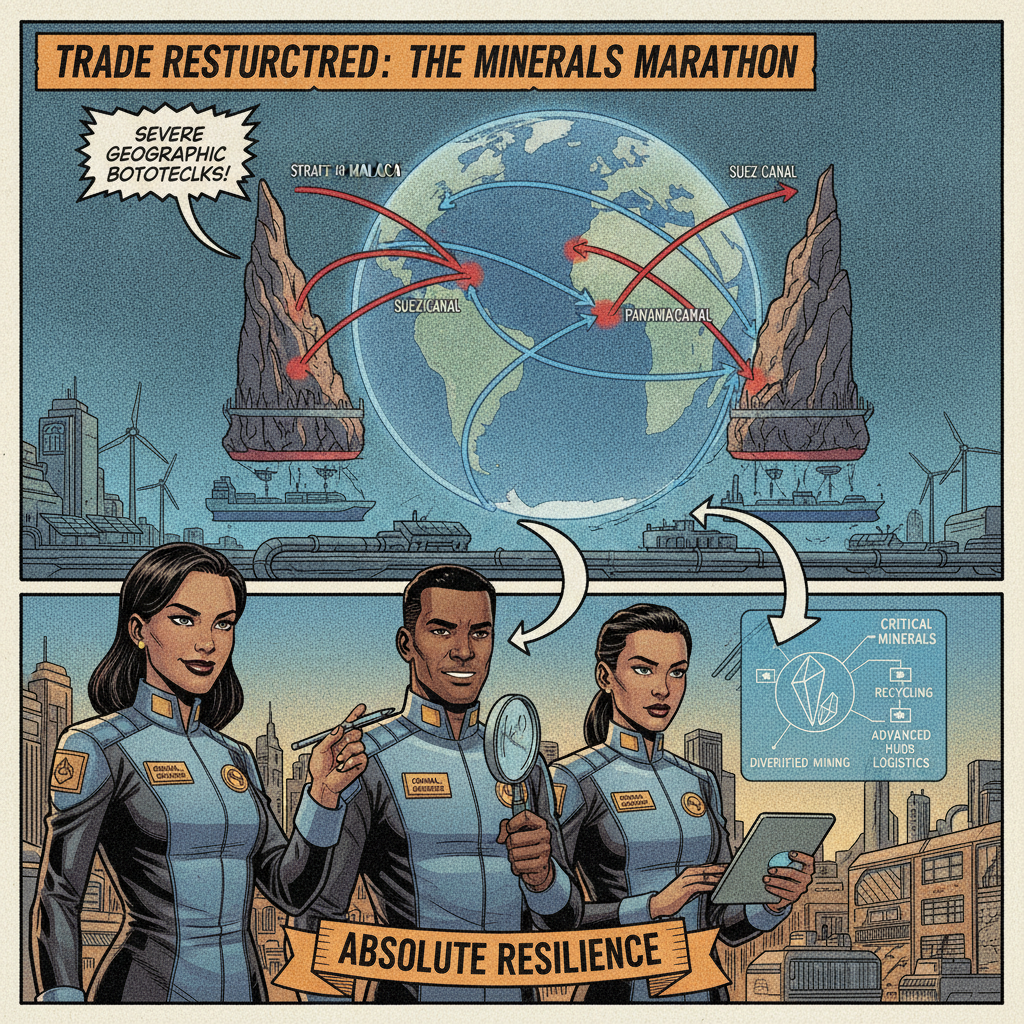
The core challenge for maritime and freight operators lies in extreme geographic bottlenecks. In 2025, the Democratic Republic of the Congo accounted for 74% of global cobalt mine production, while China dominated with 78% of natural graphite output. Furthermore, stringent export controls on seven heavy rare earth elements introduced in 2025 forced significant downstream shipping delays and halted auto-manufacturing operations globally. In response, the logistics sector is shifting focus from mere cost-efficiency to absolute supply security. As data center expansion and energy transitions demand vastly more physical inputs by 2026, securing reliable transport routes is paramount.
New Imperatives for Transport and Freight Leaders
To de-risk the critical minerals supply chain, logistics professionals must actively pivot their strategies:
- Route Diversification: Capitalizing on the February 2026 Critical Minerals Ministerial frameworks, where 54 nations committed to fostering secure, end-to-end transport and logistics networks.
- Advanced Traceability: Implementing robust origin-tracking mechanisms to navigate evolving import restrictions and effectively trace raw materials from mine to port.
- Strategic Stockpiling: Developing agile warehousing solutions near alternative processing hubs across Latin America and Southeast Asia.
Ultimately, shipping experts must treat the critical minerals supply chain not just as a procurement pipeline, but as a crucial geoeconomic asset requiring dynamic, resilient logistics architecture.
References
- Industrial Info Resources, IEA: Global Critical Minerals Risks Became Realities in 2025 (July 2026)
- Enki AI, Critical Minerals: The #1 Data Center Risk for 2026 (February 2026)
- UNCTAD, Critical minerals are reshaping global trade as demand surges (June 2026)
- IEA, Market overview – Global Critical Minerals Outlook (2026)
- U.S. Department of State, 2026 Critical Minerals Ministerial (February 2026)
- OECD, Overview: Enhancing Resilience Through Traceability (September 2026)