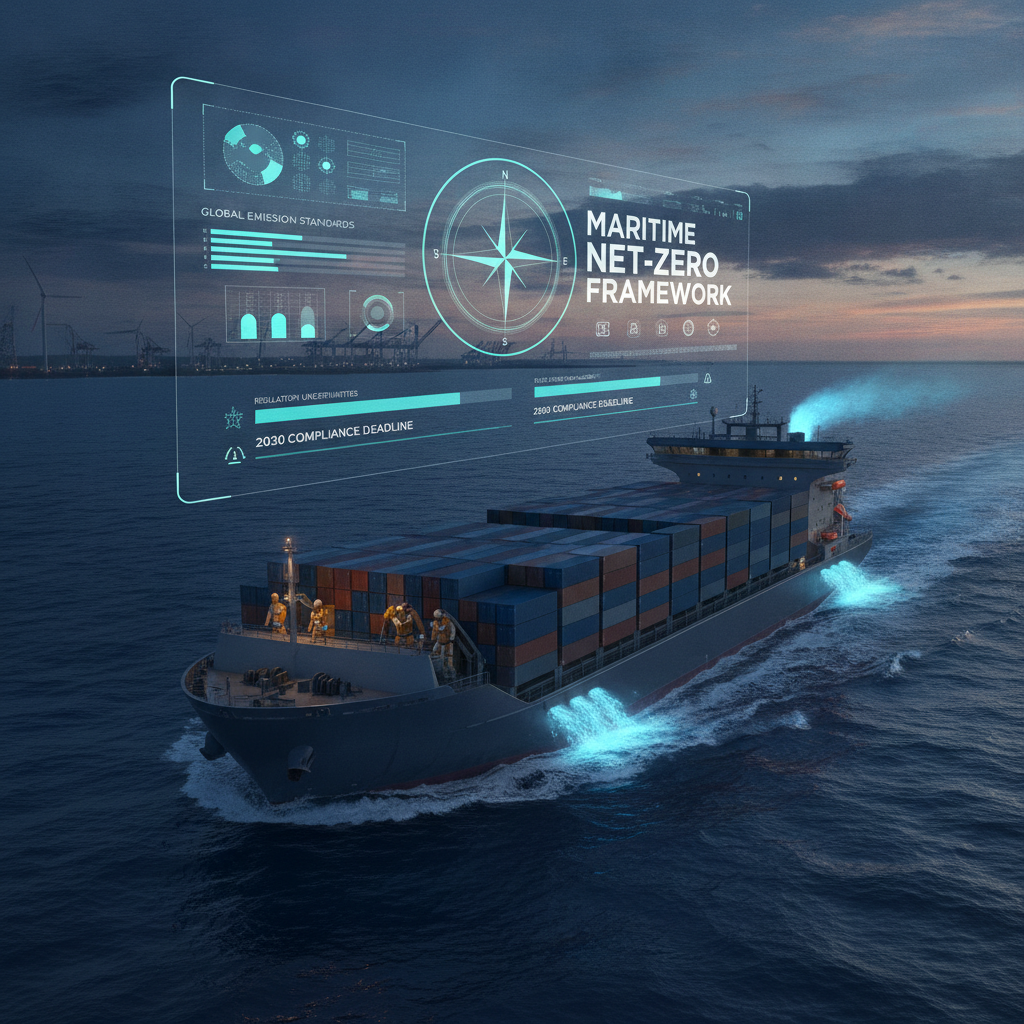
The global shipping industry stands at a critical crossroads as the International Maritime Organization (IMO) pushes forward with its Maritime Net-Zero Framework.
With shipping accounting for nearly 3% of global greenhouse gas emissions, logistics leaders are monitoring the financial implications of these regulations.
Understanding the Maritime Net-Zero Framework
Approved in draft form during MEPC 83, the Maritime Net-Zero Framework introduces a two-pillar strategy combining technical and economic measures. The framework mandates self-reported data from vessels over 5,000 gross tonnage, shifting enforcement onto national port authorities.
- GHG Fuel Intensity (GFI): A technical standard enforcing incremental reductions in emissions per unit of energy.
- Economic Mechanism: A two-tiered pricing structure for exceeding GFI baselines, with penalties potentially reaching $380 per tonne of CO2 equivalent.
Overcoming Maritime Net-Zero Framework Hurdles
Despite the timeline, the maritime sector faces significant challenges in adopting the Maritime Net-Zero Framework.
A September 2026 report highlighted that shipping is at risk of missing its 2030 target of 5-10% scalable zero-emission fuel uptake. This lag is attributed to geopolitical instability and regulatory uncertainty surrounding delayed adoption during MEPC 84.
As discussions continue to resolve disputes over the Net-Zero Fund, experts urge immediate action. Operators must integrate carbon-accounting tools and alternative fuels now to ensure future compliance.
References
IMO. “The IMO Net-Zero Framework – FAQs.”
DNV. “IMO MEPC 84: Revisiting the Net-Zero Framework.”
ClassNK. “Preliminary Report of IMO MEPC 83.”
Global Maritime Forum. “Climate action in shipping.”
Seatrade Maritime. “MEPC 83’s net-zero framework by the numbers.”
MDPI. “Evaluating GHG Fuel Intensity of Marine Fuels.”