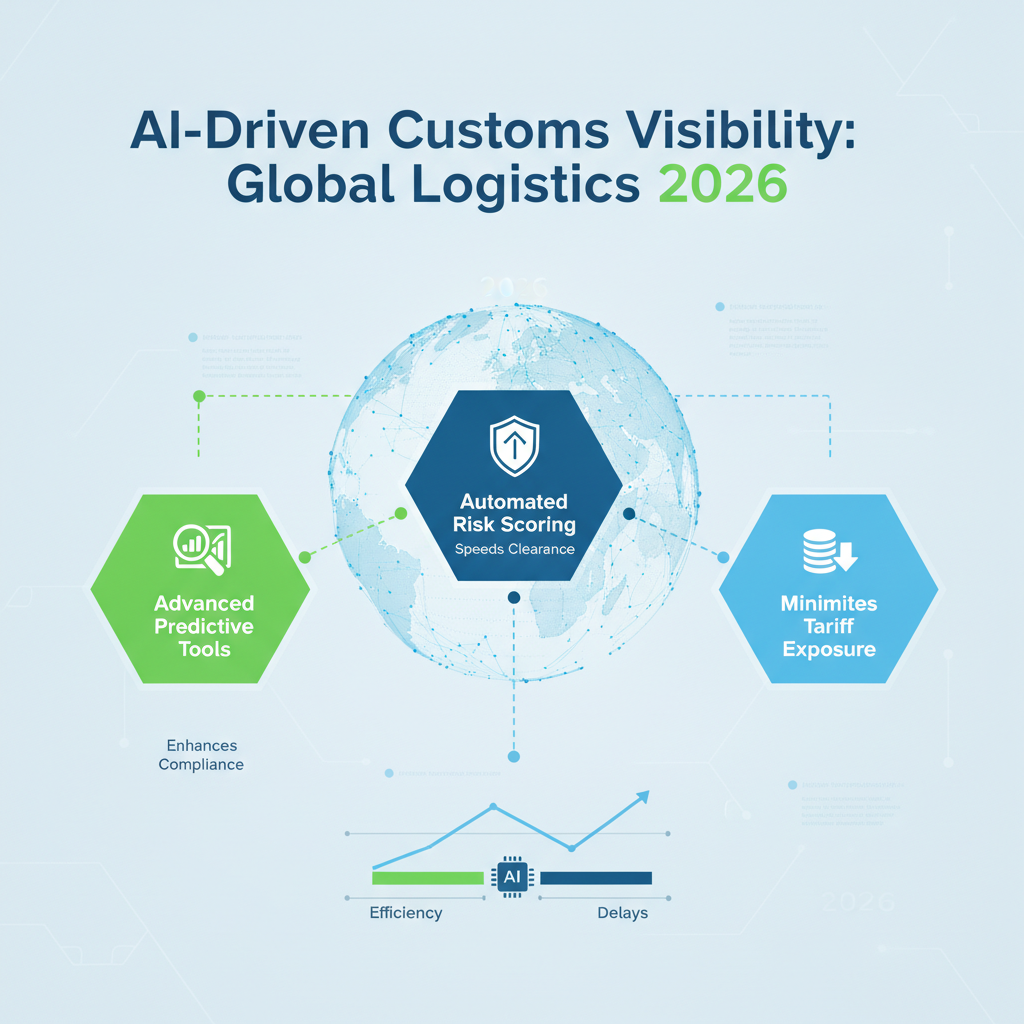
In 2026, the shift to AI-Driven Customs Visibility has fundamentally altered how logistics professionals manage cross-border trade. Recent World Customs Organization (WCO) findings show AI has moved into scaled operational realities for global supply chains. With 72% of businesses identifying tariff volatility as their primary regulatory hurdle, the demand for immediate, data-backed insights is surging.
AI-Driven Customs Visibility in Financial Enforcement
Customs authorities worldwide use AI to maximize enforcement. U.S. Customs and Border Protection (CBP) utilized AI-powered anomaly detection to collect $182.22 million from just 181 audits by April 2026, averaging over $1 million in recovery per audit. Similarly, China’s customs network embeds machine learning to read documents, score risks, and route shipments autonomously.
Predictive Tools Advancing AI-Driven Customs Visibility
To navigate strict regulations, logistics providers are launching sophisticated platforms. In September 2026, DHL introduced TradeNavigator, enabling users to query customs data via natural language. This AI-Driven Customs Visibility allows professionals to evaluate duty spend and clearance performance instantly. Japan is also enhancing its Vision 2030 by deploying AI for large-scale X-ray image analysis.
The Human Element in Digital Trade
Despite technological leaps, experts emphasize AI cannot replace professional expertise. By automating missing data identification, AI empowers logistics leaders to focus on strategic compliance decisions. References: Carra Globe (CBP Customs Audit 2026); mic-cust.com (AI-assisted trade 2026); DHL (TradeNavigator Launch); Asian Development Bank (Trade Facilitation 2026).