Maritime Decarbonisation: The 2026 Regulatory Landscape
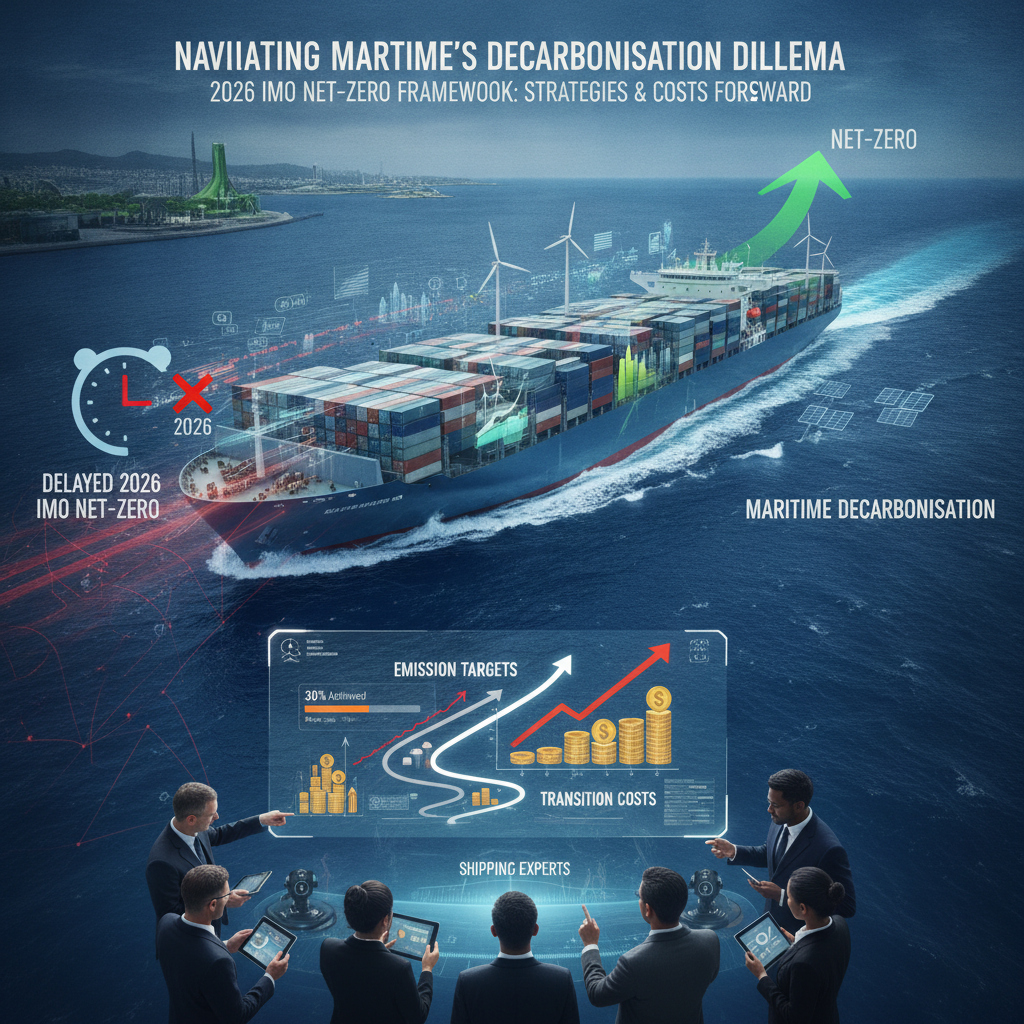
The maritime industry is at a critical crossroads. Accounting for approximately 3% of global greenhouse gas emissions, the sector is facing immense pressure to accelerate Maritime Decarbonisation. While the International Maritime Organization (IMO) approved the draft Net-Zero Framework at MEPC 83 in April 2025, its formal adoption has been controversially adjourned to late 2026. This delay extends regulatory uncertainty for logistics and shipping experts navigating the transition.
The Cost of Inaction in Maritime Decarbonisation
Despite growing ambition, progress is lagging. According to the 2025 Lloyd’s Register Global Maritime Trends Barometer, the industry’s energy transition is only 24% to 30% aligned with 2030 targets. The primary bottleneck remains the steep cost gap between conventional bunker fuels and zero-emission alternatives like green ammonia and e-methanol. To combat this, the proposed IMO Net-Zero Fund projects raising $11 billion to $12 billion annually starting in 2028 to subsidize alternative-fuel infrastructure and retrofits.
Strategic Priorities for Maritime Decarbonisation
In the absence of a finalized global policy, industry momentum is critical. Fleet operators and logistics professionals must proactively adapt to maintain competitiveness. Key focus areas include:
- Implementing immediate operational efficiencies, such as slow steaming and advanced hull coatings, to reduce baseline emissions.
- Monitoring the upcoming EU ETS and FuelEU Maritime regulations, which are already enforcing strict compliance metrics in 2026.
- Investing in crew training, as the workforce dimension of the transition currently faces chronic underinvestment globally.
References
- Lloyd’s Register: Global Maritime Trends Barometer 2025
- DNV: Maritime shipping regulation and compliance guide
- Future IMO Regulations: Zero-Emission Shipping
- ICAS: The IMO and Global Maritime Decarbonization
- Maritime Decarbonisation: Five questions for 2025
- BCG: Achieving a Sea Change in Maritime Decarbonization
- Protea Ltd: 2025 Shipping Decarbonisation