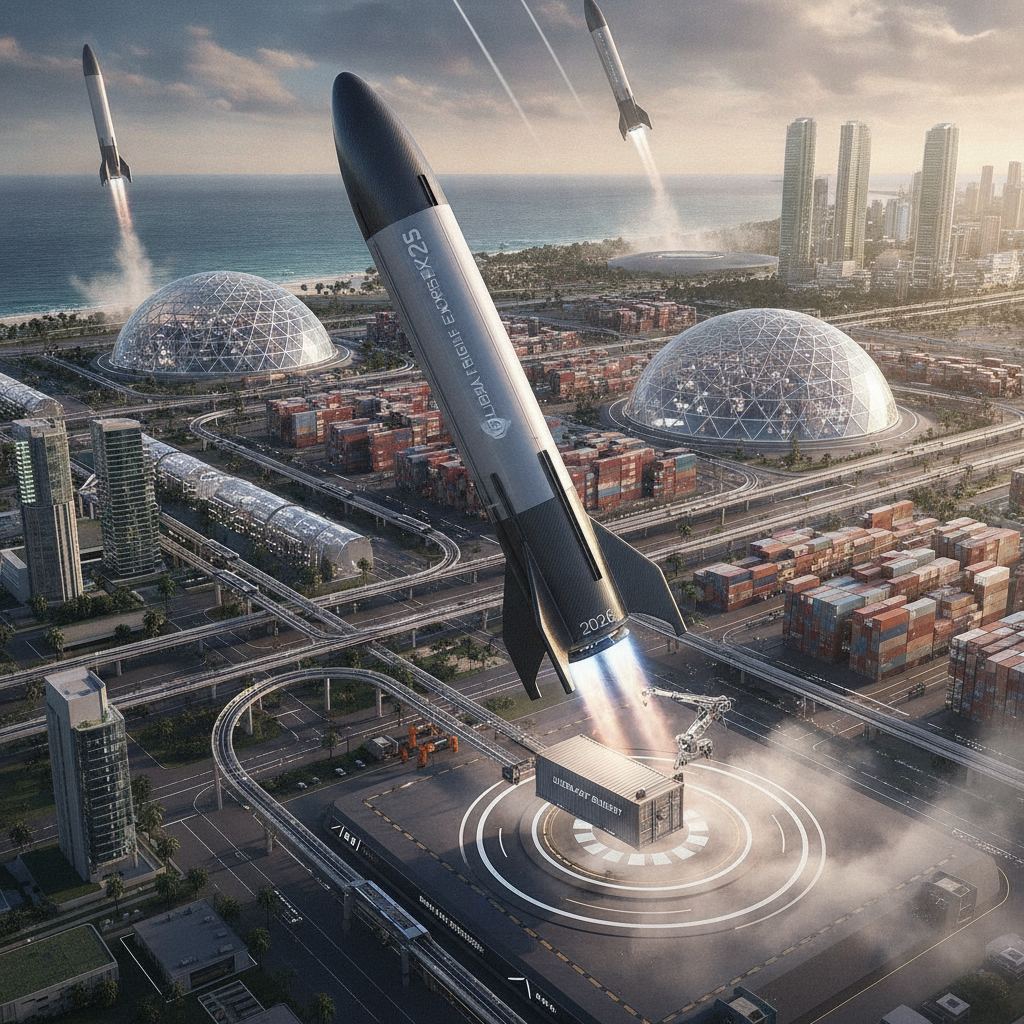
The Dawn of Space Cargo Transportation
The logistics industry is witnessing a paradigm shift in 2026 as theoretical concepts move toward real-world applications. Driven by military and commercial sector innovations, space cargo transportation promises to transport critical materiel across the globe in under 90 minutes.
Recent Breakthroughs in P2P Delivery
In October 2026, the U.S. Air Force Research Laboratory (AFRL) successfully recovered a SpaceX Starfall capsule in the Pacific Ocean, marking a landmark achievement for point-to-point rocket delivery. The capsule, capable of carrying up to one metric ton, transported lab-developed agile cargo pods equipped with sensors to measure shock, vibration, and extreme reentry temperatures. This mission advanced the Space Force’s Point-to-Point Delivery (P2PD) program, previously established in the 2025 fiscal budget.
Space Cargo Transportation Market Viability
- Speed vs. Capacity: While heavy-lift platforms like the C-17 aircraft transport 77.5 metric tons within 24 hours, the ultimate goal of next-generation rockets is delivering up to 100 metric tons anywhere on Earth within 60 to 90 minutes.
- Emerging Markets: Beyond Earth-to-Earth transport, the market is expanding to include deep space cargo transportation, in-space manufacturing, and orbital resupply missions.
Future Outlook
While rocket logistics will not replace maritime or air freight in the near term, it introduces a novel capability for ultrafast emergency transport. As launch cadence increases, commercial supply chains may soon integrate space-based fast-freight nodes into their premium logistics portfolios.
References
Global Space Logistics Market Overview, April 2026.
Space.com, SpaceX’s Starfall capsule delivers cargo, October 2026.
Space Cargo & SpaceX’s Plan, September 2026.
DVIDS, AFRL Demonstrates Rocket Cargo Delivery, October 2026.
Modern Sciences, SpaceX aims to use rockets, August 2026.
SEAS, Port-to-Port Space Economy, October 2026.