
Navigating the Critical Minerals Supply Chain
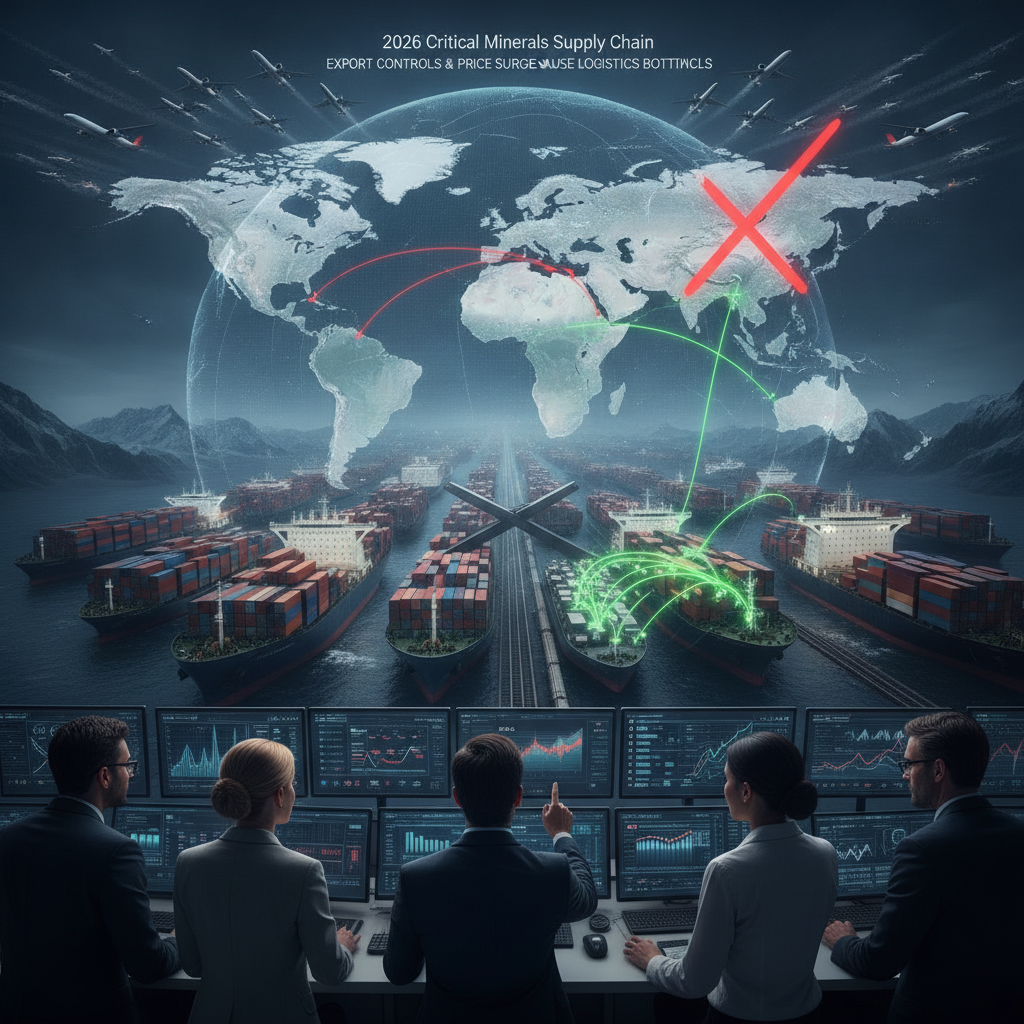
The global Critical Minerals Supply Chain is experiencing unprecedented stress in 2026. Following major export controls introduced last year, logistics experts are navigating increasingly restricted trade lanes. An International Energy Agency (IEA) July 2026 report warns that risks of concentrated supply networks have fully materialized. With China controlling about 70% of global mineral refining in 2025, recent rare earth export limits have forced a scramble for alternative shipping routes.
Logistics Impact and Freight Costs
Commodity price shocks translate directly to freight vulnerabilities. Between January 2025 and April 2026, lithium prices more than doubled and cobalt surged 130%. For carriers, this heightens material value, inflating insurance premiums and delay costs.
- Export Caps: Trade measures like Zimbabwe’s February 2026 lithium restrictions disrupt bulk freight availability.
- Bauxite Controls: Guinea’s new June 2026 export controls are rapidly tightening capacity for maritime carriers.
- Capital Shifts: Nearly 9,000 active global projects represent $1.32 trillion in capital, necessitating robust new logistics infrastructures.
Securing the Critical Minerals Supply Chain
To insulate the Critical Minerals Supply Chain, forwarders must aggressively diversify hubs. The U.S. and Europe aim to scale their global lithium supply share from 2.5% in 2025 to 19% by 2035, shifting shipping reliance away from Asia-Pacific lanes. Adaptable, multimodal transport solutions remain crucial in 2026.
References
Industrial Info Resources, IEA: Global Critical Minerals Risks Became Realities in 2025, July 2026. Critical Minerals Market to Hit USD 750.0 Billion by 2035, September 2026. TDi Sustainability, IEA Global Critical Minerals Outlook 2026, August 2026. S&P Global, Critical Minerals Intelligence, 2026.