
Drivers of the E-commerce Air Cargo Surge
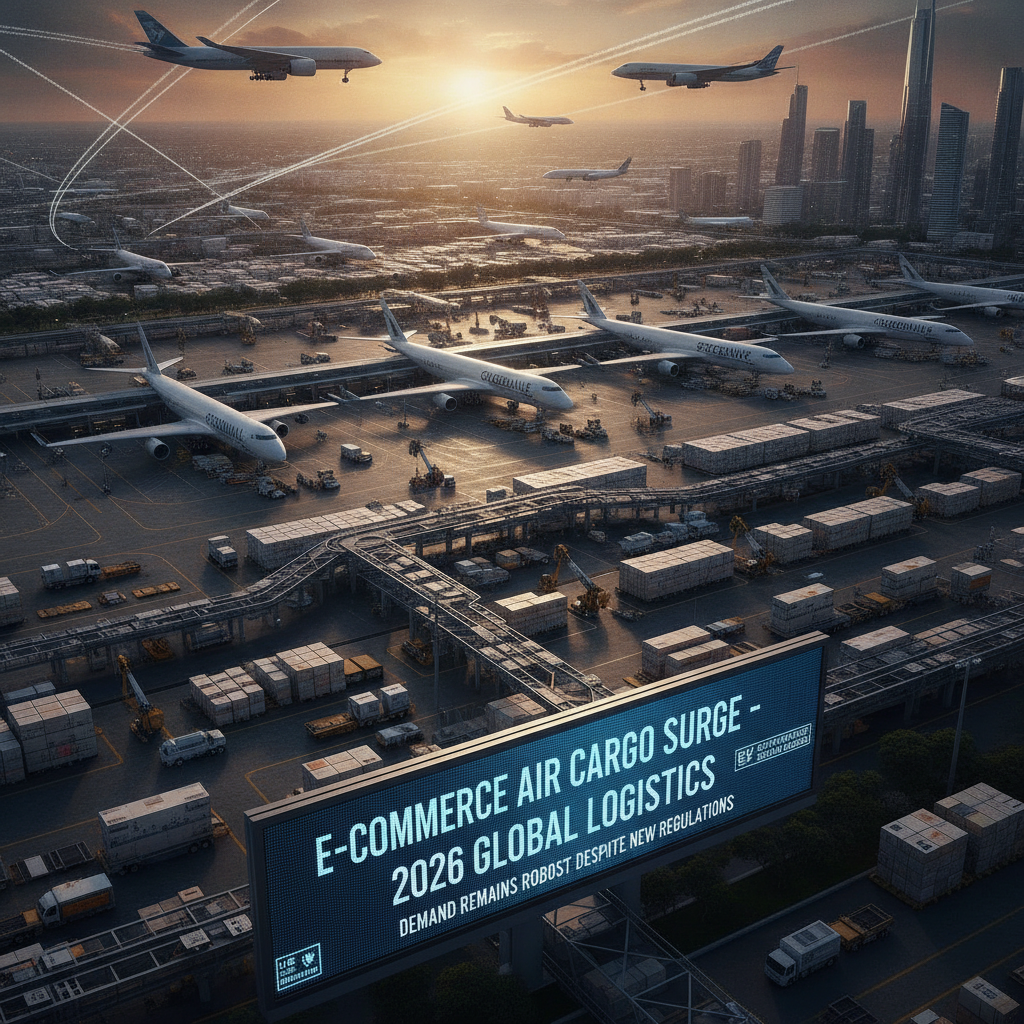
The global logistics landscape is undergoing a structural transformation, driven by an unprecedented E-commerce Air Cargo Surge. Throughout 2025 and into 2026, the aggressive expansion of direct-to-consumer platforms has profoundly disrupted traditional air freight dynamics.
Industry data reveals that leading retail giants alone ship approximately 9,000 tons of cargo daily from China, equivalent to the payload of nearly 88 Boeing 747-8 freighters. This immense volume has squeezed capacity for traditional sectors, with global spot rates jumping by 41% year-over-year in May 2026. This specific market was valued at $78.4 billion in 2025 and is forecasted to reach $85.9 billion in 2026.
How Regulations Impact the E-commerce Air Cargo Surge
Despite robust growth, the E-commerce Air Cargo Surge faces critical regulatory headwinds in 2026. Governments are actively stepping in to level the playing field:
- United States: The removal of the de minimis exemption for Chinese imports in May 2026 temporarily disrupted transpacific volumes, forcing logistics providers to pivot to Southeast Asian hubs.
- European Union: In July 2026, the EU imposed a €3 customs fee on low-value e-commerce imports, directly targeting the ultra-cheap parcel model.
The Path Forward for Logistics Experts
While new regulations have caused regional fluctuations, the underlying momentum remains remarkably strong. Shippers are rapidly diversifying their supply chains, establishing regional fulfillment centers, and blending air freight with ocean routes to manage costs.
Furthermore, as AI data center infrastructure joins e-commerce as a primary demand driver, cargo capacity will remain incredibly tight. Logistics professionals must prioritize agility and strategic capacity planning to thrive in this permanently altered environment.
References
Aevean Market Analysis (2026). Freightos Forecast (2026). CAAS Data (2026). Dataintelo Report (2026). Reuters (2026).