

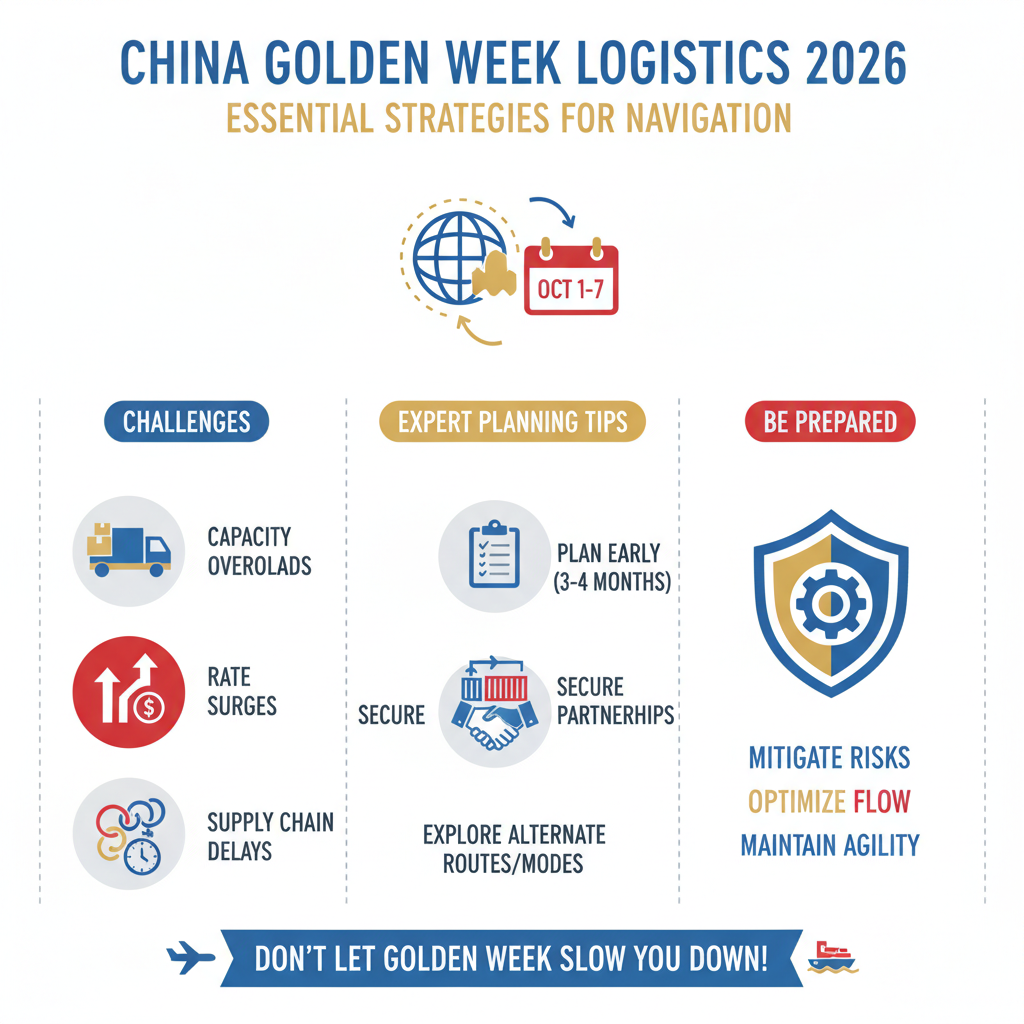
As international supply chains brace for seasonal volatility, proactive China Golden Week Logistics planning is crucial for global shipping experts. Scheduled for October 1 to 7, 2026, the annual holiday profoundly alters global trade dynamics. Because the Mid-Autumn Festival falls shortly before (September 25-27), production schedules will be compressed into a narrow window [3].
With closures affecting up to 90% of regional manufacturers, logistics managers must prepare for severe bottlenecks. Recent data models for 2026 suggest key hubs like Shanghai and Ningbo may experience up to a 40% capacity overload [1].
Without advanced preparation, shippers face severe financial and operational disruptions. Pre-holiday rushes historically boost port volumes by 30% as factories push out final shipments [2]. Professionals should anticipate these critical impacts:
- Ocean freight spot rate surges ranging from 20% to 50% [1].
- Air freight premiums jumping by up to 200% for priority cargo [1].
- Post-holiday blank sailings cutting 10% to 20% of scheduled voyages [2].
- Transit delays extending 15 to 25 days as backlogs clear [1].
To navigate this challenging peak season, forwarders must deploy resilient strategies early. Experts advise securing ocean freight allocations at least three to four weeks ahead of October 1, and air freight a minimum of one week in advance [1]. Supply chain continuity relies on buffering inventory early and confirming customs documentation well before factory closures [2].
References
[1] Mastering China Golden Week Logistics Planning for 2025-2026, July 2026.
[2] China Golden Week Logistics Planning: Are You Ready for 2026? Shipping Great, July 2026.
[3] China Golden Week 2026: Complete Supply Chain Disruption Guide for Global Traders, SEKO Logistics.