
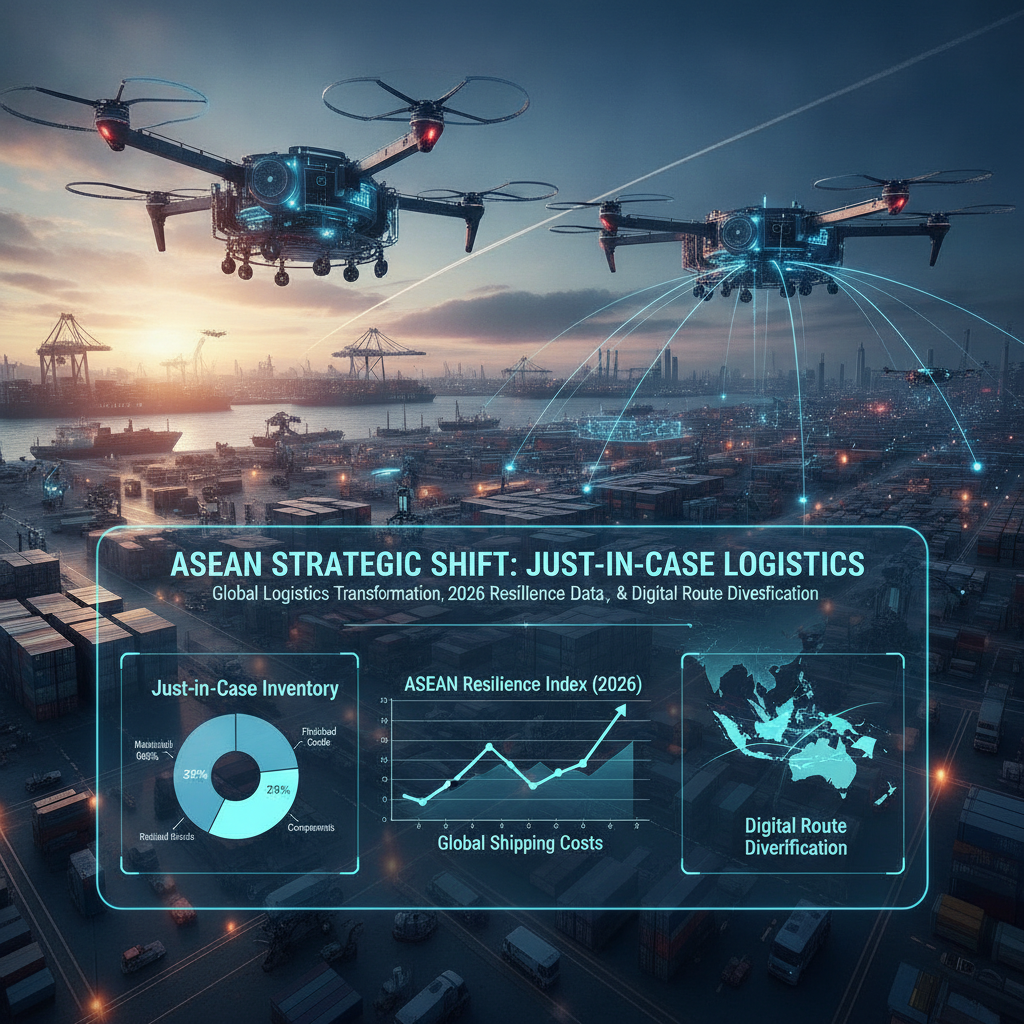
As geopolitical realignments and trade fragmentation intensify in 2026, logistics and shipping experts are closely monitoring the evolution of ASEAN supply chain resilience. The region is actively transitioning from traditional Just-in-Time (JIT) coordination to a more robust Just-in-Case (JIC) inventory management paradigm. This strategic shift is driven by a necessity to buffer against global volatility, with regional safety stock holding days increasing by an astonishing 169 percent between 2018 and 2025. Consequently, supply chain resilience scores across the ASEAN-5 have improved by an average of 18.2 index points, cementing the region’s position as an indispensable global manufacturing hub.
While establishing redundant inventory buffers enhances stability, it comes with financial implications. Current logistics costs in ASEAN average between 13 and 14 percent of GDP, notably higher than the 8 percent seen in developed markets. To offset these costs and elevate its standing in the Global Value Chain (GVC), the ASEAN Economic Community Strategic Plan 2026-2030 targets critical sectors like semiconductors, healthcare, and consumer electronics. Industry leaders are leveraging several strategies to optimize efficiency:
- Digital Transformation: Integration of AI forecasting and predictive analytics to create hybrid JIT-JIC models.
- Route Diversification: Adoption of alternative shipping routes and leveraging comprehensive economic partnerships to mitigate maritime bottlenecks.
- Regional Industrial Cooperation: Enhancing intra-ASEAN connectivity to minimize cross-border friction and facilitate agile production scaling.
Ultimately, ASEAN supply chain resilience is no longer just about offering a low-cost alternative. It has matured into a deeply connected, technologically enabled regional production ecosystem capable of absorbing macro-economic shocks while sustaining global trade flows.
References
Transitioning from Just-in-Time to Just-in-Case: A Strategic Model for Manufacturing Resilience in ASEAN Hubs (ResearchGate, 2026). The Hormuz Playbook: How ASEAN Companies Are Rerouting Supply Chains (2026). ASEAN Economic Community Strategic Plan 2026-2030 (2025). Why ASEAN Region Is No Longer Just a Low-Cost Base (Source of Asia, 2026).