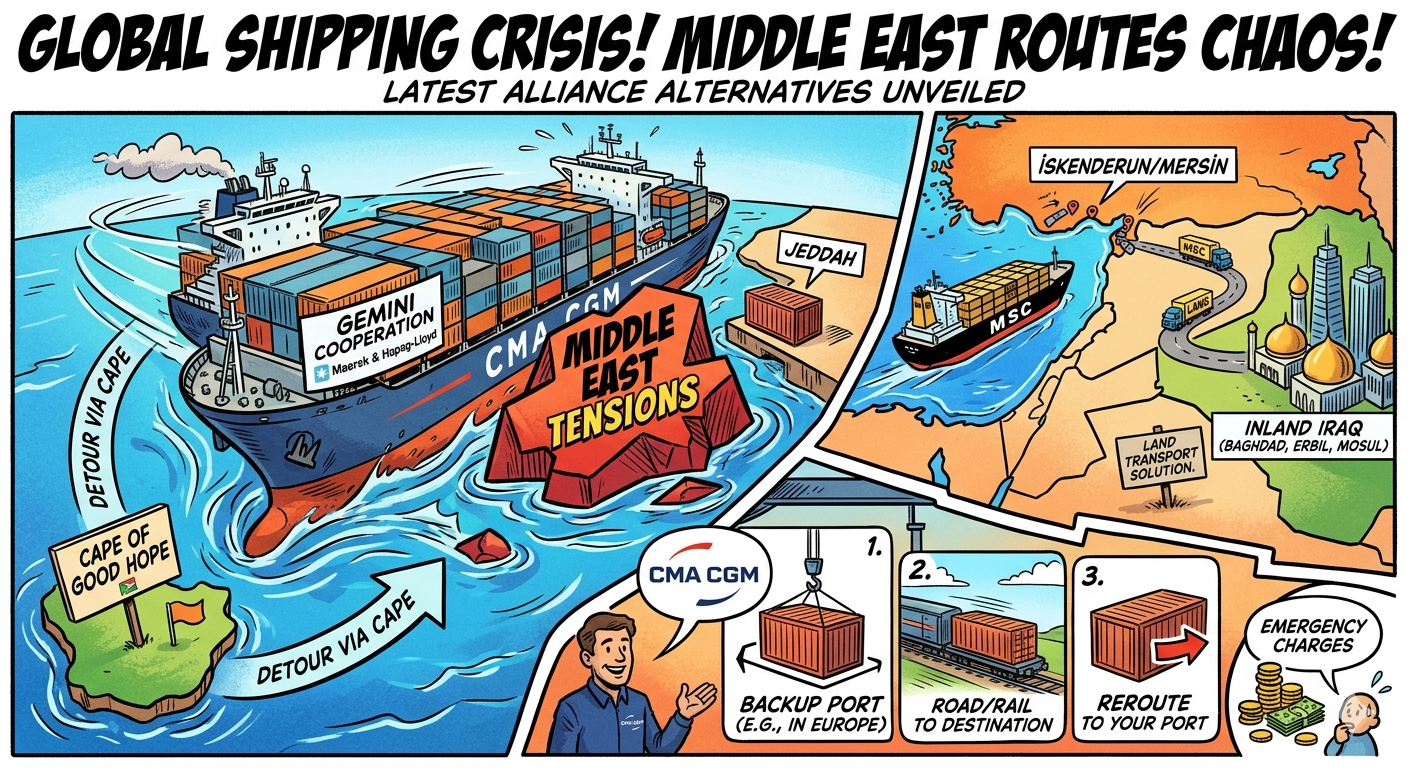
Given the ongoing escalation of tensions in the Middle East—which has led to the suspension of operations at several ports and the halting of bookings by liner companies—regional transportation has been severely impacted. In response, several major carriers have announced updated alternative routing plans.
Gemini Cooperation: Maersk and Hapag-Lloyd Launch New Route
On March 6, Gemini Cooperation members Maersk and Hapag-Lloyd announced the launch of a new service on their respective websites: the Maersk AE19 and Hapag-Lloyd SE4. This route will detour around the Cape of Good Hope and call at Jeddah, Saudi Arabia.
Port Rotation: Tianjin Xingang – Qingdao – Busan – Ningbo – Shanghai – Tanjung Pelepas – (Cape of Good Hope) – West Med Hub – East Med Hub – Jeddah – East Med Hub – West Med Hub – (Cape of Good Hope) – Singapore – Tianjin Xingang.
The maiden voyage will be made by the vessel Maersk Elba, scheduled to depart from Tianjin Xingang on March 13.
MSC: Land Transport Solutions
On March 5, Mediterranean Shipping Company (MSC) introduced a specialized solution for cargo destined for inland Iraq to navigate current regional challenges.
MSC stated that its Tiger and Phoenix services provide competitive transport from Asia to Turkey. From there, the company offers customized transit to inland Iraq via:
- Iskenderun (via the Phoenix service)
- Mersin (via the Tiger service)
Key Inland Destinations: Zakho, Dohuk, Mosul, Erbil, Sulaymaniyah, and Baghdad.
CMA CGM: Three Contingency Options
CMA CGM recently announced emergency measures for all cargo traveling to and from Iraq (Port of Umm Qasr), Bahrain, Kuwait, Yemen, Qatar, Oman, the UAE, and Saudi Arabia.
Customers are offered three primary options:
- Delivery at an Alternative Port: Cargo is delivered to a backup port (after loading), and equipment must be returned there.
- Intermodal Redirection: Transportation via road or rail to a location specified by the customer, subject to negotiation on pricing and feasibility.
- Route Diversion: Rerouting cargo to a port of the customer’s choice, based on negotiated rates, service availability, and port capacity.
Financial Terms:
- All costs arising from these Bill of Lading clauses will be borne by the cargo owner.
- An Emergency Contingency Surcharge (ECS) must be paid before cargo release (except for shipments originating from the U.S.).
- All related costs at alternative ports—including detention, demurrage, storage, and handling—are the responsibility of the customer.